


AB 1572 in San Diego: Lawn Rules for Businesses and HOAs
October 26, 2026
AB 1572 sets deadlines for stopping drinking-water irrigation of decorative lawns. In San Diego, the deadline is January 1, 2027, for public agencies; January 1, 2028, for businesses and institutions; and January 1, 2029, for HOA common areas.
Your first step: confirm your water source and document how each lawn area is used. Single-family homes are excluded, but shared community landscaping can be covered. Grass used for qualifying recreation or civic events is treated differently from decorative turf.
For your 2027–2028 budget, compare plants, hardscape, artificial turf, or a mix based on use, drainage, heat, maintenance, and rebate rules. To size up the turf option, start with how much water artificial turf saves. Later self-certification dates do not extend watering deadlines.
Check requirements with your water agency before approving work, since the law doesn’t require replacing grass. If turf makes your shortlist, see how commercial turf installation handles heavy-use areas.
Functional vs. Nonfunctional Turf
The difference comes down to purpose. Nonfunctional turf is mowed grass used mainly for decoration - not recreation or community activities. Classification depends on how the lawn is used and the conditions on-site, not its label on a landscape plan.
Decorative Grass vs. Active-Use Grass
Grass used for play or gatherings is functional. Decorative grass that people cross only to reach a building is nonfunctional.
| What to check | Functional turf | Nonfunctional turf |
|---|---|---|
| Actual use | Documented play, recreation, or community gatherings | Ornamental landscaping |
| AB 1572 watering treatment | Not subject to this law’s nonfunctional-turf restriction | Drinking-water irrigation becomes restricted at the applicable property deadline |
| Useful documentation | Activity records, dated photos, lawn dimensions, and irrigation maps | Photos of site conditions, lawn dimensions, water sources, and irrigation maps |
This distinction determines which turf square footage you must track against the applicable deadline.
Unsure how to classify an area? Send photos, a site map, and activity records to your water agency before treating it as exempt.
Map Lawn Uses and Irrigation Zones
Map each turf area’s square footage, activity, valve or controller station, and water source. Include dated photos, and record decorative strips separately from recreation areas - even if they share a valve.
Check shared irrigation lines before changing watering schedules so you don’t cut water to trees or planting beds.
After mapping each turf area, match it to the deadline for your property type.
sbb-itb-2b3b7d5
AB 1572 Deadlines and Self-Certification
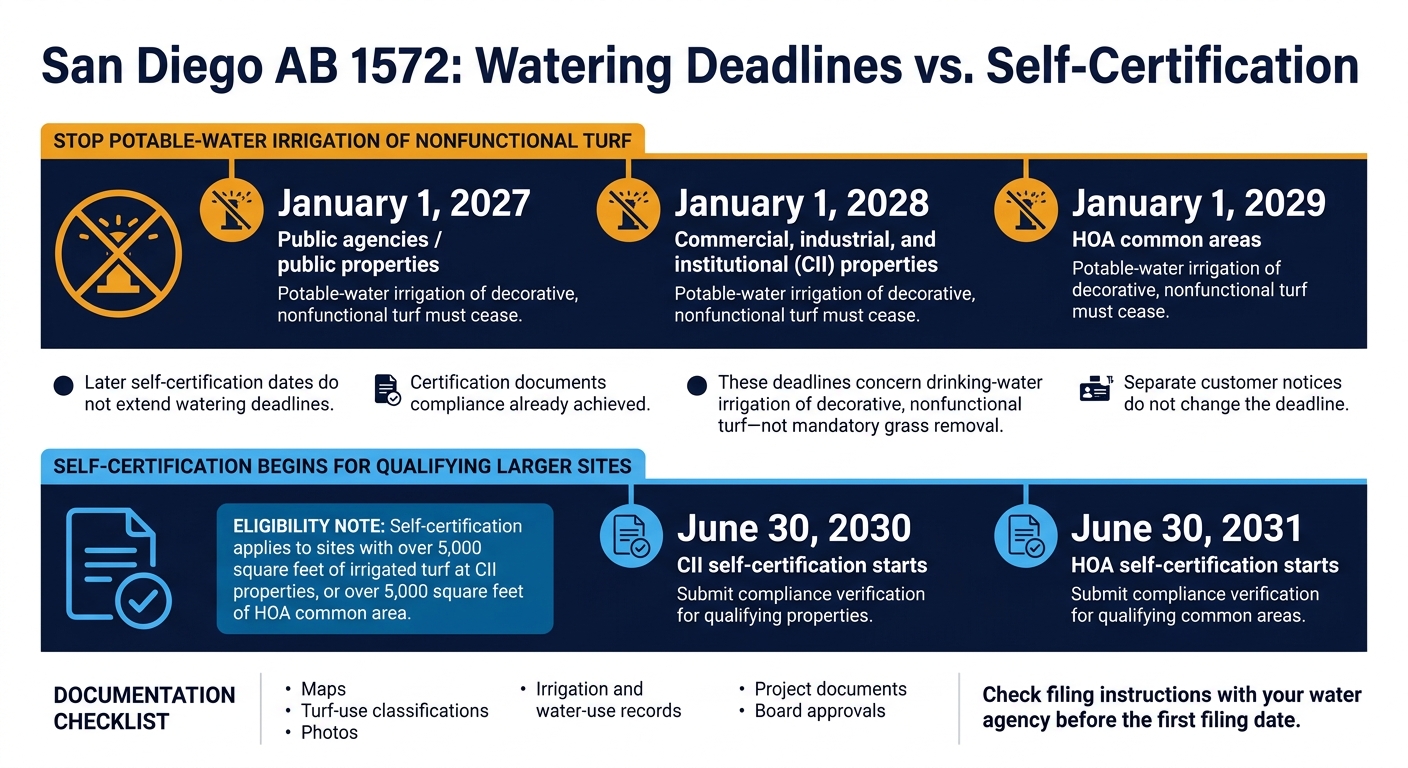
San Diego AB 1572: Watering Deadlines vs. Self-Certification
After classifying each turf area, match it to the correct deadline.
Watering Deadlines by Property Type
The watering deadline comes first; self-certification comes later. AB 1572 sets the following dates for ending potable-water irrigation of nonfunctional turf:
| Property type | Potable watering must stop |
|---|---|
| Public agencies / public properties | January 1, 2027 |
| Commercial, industrial, and institutional (CII) properties | January 1, 2028 |
| HOA common areas | January 1, 2029 |
Public agencies must meet the deadline on their own landscapes. Water agencies may send separate customer notices, but those notices do not change the deadline.
Plan your budget around the stop-watering date. The later certification date is for documentation only.
Self-Certification Rules for Larger Sites
Self-certification applies to sites with over 5,000 square feet of irrigated turf at CII properties, or over 5,000 square feet of HOA common area.
CII self-certification starts June 30, 2030. HOA self-certification starts June 30, 2031. These reporting dates do not give properties more time to stop watering. Certification documents compliance already achieved.
Keep maps, turf-use classifications, photos, irrigation and water-use records, project documents, and board approvals. Check filing instructions with your water agency before the first filing date.
Landscape Options and 2027–2028 Budgets
Once you’ve identified nonfunctional turf, compare replacement options and set a budget for each zone.
Compare Artificial Turf, Plants, and Hardscape
Choose based on site use, maintenance, and drainage - not looks alone. Watering nonfunctional turf less won’t meet the rules. Potable irrigation must stop by the deadline.
| Landscape option | Best fit | Maintenance | Irrigation and drainage | Planning question |
|---|---|---|---|---|
| Artificial turf | High-traffic courtyards and pet areas | Debris removal, brushing, and cleaning | The turf itself needs no irrigation, but rinsing may use water. Drainage depends on the complete system. | How will heat, pets, and foot traffic affect use? |
| Climate-appropriate plants and mulch | Decorative borders and low-traffic areas | Weeding and seasonal pruning | Plan for drip irrigation and check soil absorption. | How much establishment watering will plants need? |
| Permeable hardscape | Walkways and outdoor seating | Sweeping and surface cleaning | No irrigation; drainage depends on materials and the base. | Can the site support the proposed drainage design? |
| Functional turf | Qualifying recreation and active-use areas | Mowing and lawn care | Still needs irrigation. | Can irrigation run separately from nonfunctional grass? |
| Mixed landscape | Properties with several distinct uses | Separate care schedules by zone | Keep planted, turf, and paved areas separate. | Who will maintain each surface? |
Check rebate eligibility before approving materials or removing turf. Many rebates exclude synthetic turf and favor living, drought-tolerant plants. Confirm your water agency’s requirements before including a rebate in the budget.
If artificial turf fits the site, the next step is to assess the space, drainage, and traffic patterns.
Plan Commercial Artificial Turf Installation
Start commercial turf installation with a site assessment. Measure the space, check existing drainage, and map foot traffic and pet use. Review appearance standards before choosing a system.
Inland sites such as El Cajon also need heat-mitigation planning. Specify heat-mitigation features where needed.
Set the Project Budget
For 2027–2028 budgets, request separate allowances for assessment, design, demolition and haul-away, base installation, materials, infill, labor, and routine maintenance. Use the commercial cost-planning guide to shape your questions for contractors.
Plan around the stop-watering date, with construction finished before compliance deadlines. Allow time for HOA review, too: HOAs can still set appearance and quality standards. Base water-use estimates on actual irrigation records, plant needs, and water used for cleaning.
Give every bidder the same written scope so design, demolition, materials, and maintenance are priced on the same basis.
Conclusion: Your AB 1572 Planning Checklist
AB 1572 limits potable-water irrigation of nonfunctional turf. Single-family homes are excluded. Stop-watering deadlines vary by property type:
- Public agencies: January 1, 2027
- Commercial, industrial, and institutional properties: January 1, 2028
- HOA common areas: January 1, 2029
Start by confirming whether your property is covered. Then measure turf areas, map irrigation zones, verify water sources, and document how each area is used. Contact your water agency to check local requirements and rebate eligibility.
Use your deadline to set the 2027–2028 budget. Document each zone and choose the fix that fits it. If turf is an option, weigh how long artificial turf lasts against the upkeep of plants or hardscape.
Keep maps, water-source records, activity records, and project paperwork. Sites with 5,000+ square feet of irrigated turf also have later self-certification duties: June 30, 2030, for commercial, industrial, and institutional properties, and June 30, 2031, for HOAs.
United Turf & Pavers handles commercial turf installation in San Diego, and its planning reviews confirm measurements and drainage needs. A planning review does not replace a legal compliance determination.
FAQs
Can I use recycled water on nonfunctional turf?
AB 1572 restricts the use of drinking water to irrigate nonfunctional turf. The provided information doesn’t confirm whether recycled water is allowed. Check with your local water agency or review the statute before using recycled water, as irrigation rules can vary by jurisdiction and water district.
Does occasional recreation make my lawn functional under AB 1572?
Not necessarily. Under AB 1572, nonfunctional turf is grass that isn’t regularly used for human recreation or community events. What matters is the lawn’s main purpose and how it’s used. If it’s mostly decorative or sits in an area not designed for active use, it’s likely nonfunctional. The possibility of occasional foot traffic alone doesn’t make it functional.
How do I protect trees that share my lawn’s irrigation?
Before installing artificial turf, have a professional inspect irrigation lines shared with trees or other landscaping. Cap or reroute those lines before compacting the base, while keeping water flowing to your trees. Fix any leaks to help prevent soft spots or sinking beneath the new turf.
Before sealing the turf area, make sure a separate, dedicated irrigation system supplies enough water to your trees’ root zones.