.webp)
.webp)

Artificial Turf Costs in San Diego: Residential vs. Commercial
August 5, 2026
Residential turf in San Diego usually costs more per square foot, while commercial turf usually costs more overall.
If you want the short answer, here it is: most homes land around $8 to $15 per sq. ft., with many jobs near $15 per sq. ft., while large commercial installs often come in around $8 to $12 per sq. ft. at scale. Your final price usually comes down to site access, grading, drainage, turf type, and project size.
Before you budget, focus on these points:
- Residential jobs often cost more per sq. ft. because crews deal with tight side yards, hand-carried materials, and smaller job sizes
- Commercial jobs often get a lower unit price, but the total bill is higher because the install area is much larger
- Drainage and grading can add a lot, especially on clay soil, slopes, or older lots
- Permits and local rules can affect cost, mainly in the Coastal Zone or when grading and drainage work are part of the job
- Maintenance stays lower than natural grass, but commercial turf usually needs more brushing, cleaning, and infill work
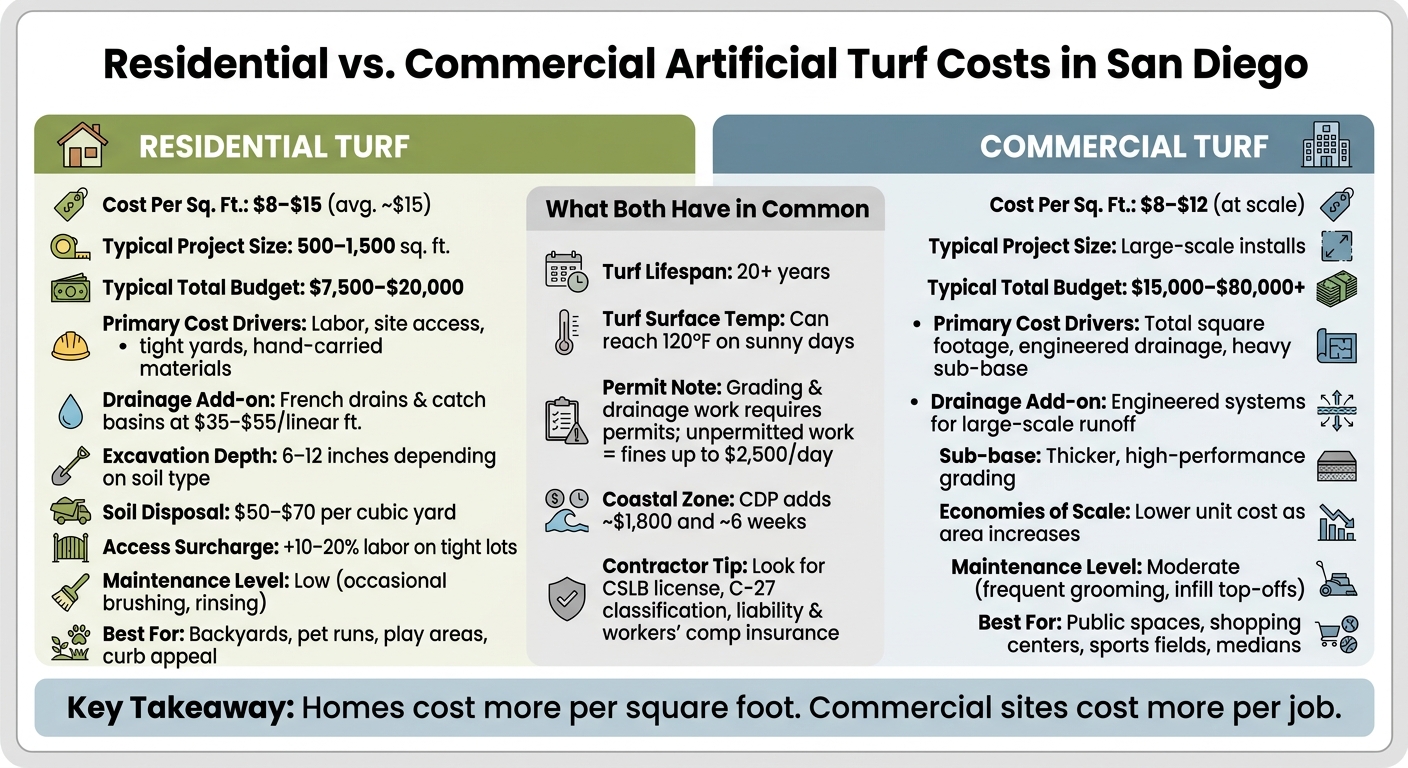
Residential vs. Commercial Artificial Turf Costs in San Diego
Navigating the Cost of Artificial Turf: Tips for Budgeting and Financing
sbb-itb-2b3b7d5
Quick Comparison
| Project Type | Typical Cost per Sq. Ft. | Typical Size | Main Cost Drivers | Typical Total Budget |
|---|---|---|---|---|
| Residential | $8–$15 | 500–1,500 sq. ft. | Access, labor, excavation, drainage | $7,500–$20,000 |
| Commercial | $8–$12 | Large-scale installs | Total area, drainage, wear needs, sub-base work | $15,000–$80,000+ |
If you’re comparing home and commercial turf, the main thing to know is simple: homes cost more by the foot; commercial sites cost more by the job. Financing closes the gap between these ranges and what's comfortable to pay upfront. GreenSky's 0% APR plans fit a standard residential install, while Lyon Financial's fixed-rate loans suit a larger commercial job. Ask about financing plans for either project size before comparing bids.
Upfront Installation Costs: Residential vs. Commercial
Residential Turf Costs for Typical San Diego Homes
For most San Diego homeowners, the price of artificial turf depends less on the turf itself and more on what has to happen before it goes down.
Installed artificial turf usually runs $8 to $15 per square foot, with local averages close to $15.
If you break that down, materials alone cost about $1.29 to $6.50 per sq. ft. Labor and installation add another $8.90 to $15.60 per sq. ft.. That’s why a 500–800 sq. ft. backyard often lands in the $7,500 to $12,000 range, while an 800–1,500 sq. ft. full backyard project usually comes in at $12,000 to $20,000.
Site prep can shift the budget fast. Hauling away dense clay soil or bringing in fill costs $50 to $70 per cubic yard. In many yards, the base is 3 to 4 inches of compacted crushed rock. But soil conditions in San Diego vary a lot. Inland spots like Poway or Santee often need 8 to 12 inches of excavation, while coastal sandy soils usually need 6 to 8 inches.
Drainage can add another layer of cost. French drains and catch basins run $35 to $55 per linear foot and are often needed on sloped lots or properties with heavy clay soil. And if you’re dealing with an older neighborhood with narrow side yards, labor and delivery costs can climb by 10% to 20%.
That helps explain why commercial pricing works a bit differently.
Commercial Turf Costs for Larger Properties
On commercial jobs, the focus shifts from basic yard prep to long-term wear, drainage, and performance under heavier traffic.
Installed commercial turf systems often cost around $8 to $12 per sq. ft. at scale. The per-square-foot number can look lower than a home project, but the full budget is still much higher because the install area is much larger.
Commercial systems also tend to use thicker turf, more infill, and engineered drainage to handle steady foot traffic.
Side-by-Side Cost Table: Residential vs. Commercial Turf
| Feature | Residential Turf | Commercial Turf |
|---|---|---|
| Installed Cost per Sq. Ft. | $8–$15 | $8–$12 (premium commercial, at scale) |
| Typical Project Size | 500–1,500 sq. ft. | Larger-scale installs |
| Prep Intensity | Moderate (3–4" crushed rock base) | High (heavy grading, thicker sub-base) |
| Drainage Complexity | Standard French drains or catch basins | Engineered systems, large-scale runoff management |
| Maintenance Burden | Low (occasional brushing and rinsing) | Moderate (frequent grooming for high traffic) |
| Best-Fit Use Case | Backyards, pet runs, play areas, curb appeal | Public spaces, shopping centers, sports fields, medians |
The gap in per-square-foot pricing gets smaller as projects get bigger. But commercial work usually costs more overall because the footprint is larger and the system has to meet a tougher performance standard.
What Affects the Price Most
Once you get past base pricing, the biggest jumps usually come from access, grading, drainage, and turf type.
Size, Access, and Site Preparation
A lot of people assume square footage is the main thing that changes the bill. Sometimes it is. But on many jobs, access matters even more than size, especially on tight residential lots.
That shows up all the time in older San Diego neighborhoods like North Park or Normal Heights. Homes are close together, and side yards can be very narrow. If a crew can't get equipment through, they have to carry materials in by hand. That step alone can bump labor costs by 10% to 20%. Commercial sites usually have fewer access problems, but they often bring other issues, like larger seams, demolition work, and more moving parts to coordinate.
Soil conditions also change the prep work. Inland clay often needs 8 to 12 inches of excavation, while coastal sand usually needs 6 to 8 inches. If clay has to be hauled off-site, disposal runs $50 to $70 per cubic yard. And then there are the surprises nobody wants. Buried sewer issues can add $1,500 to $3,500 in repairs.
Hillside lots are their own story. Minor leveling usually costs $500 to $1,000, while more involved grading can run past $10,000.
Once the base is ready, the turf spec starts driving the next round of costs.
Turf Type, Drainage, and Intended Use
The way the space will be used has a direct effect on price. Pet turf, play-area padding, putting greens, and heavy-use commercial systems all cost more than a standard install.
Drainage is another big factor, and it shows up a little differently on residential and commercial jobs. On residential lots with clay soil or poor drainage, installers often need French drains and catch basins. Those usually cost $35 to $55 per linear foot. Commercial projects may have better access, but they still need drainage systems that can deal with heavier runoff cleanly.
Heat is adding pressure too, especially inland. Artificial turf can hit 120°F on a sunny afternoon. That has more homeowners and commercial property managers looking at cooling infill systems, which adds to the upfront price.
After installation, maintenance becomes the next big place where costs start to split.
Long-Term Costs and San Diego Project Limits
Maintenance Costs: Home Yards vs. Commercial Sites
Once the turf is in, the cost picture changes. You’re no longer focused on installation alone. Now it’s about upkeep.
For most home yards, upkeep is light but not nonexistent. That usually means occasional brushing, clearing leaves and debris, and rinsing pet areas when needed. Natural grass, on the other hand, keeps adding work and expense through mowing, fertilizer, and watering.
Commercial properties usually need more attention. Heavy foot traffic wears the surface faster, so brushing happens more often and infill needs periodic top-offs. And with more square footage, cleaning simply takes longer.
| Maintenance Task | Residential | Commercial / High-Traffic |
|---|---|---|
| Brushing | Occasional | Frequent |
| Rinsing / Cleaning | As needed | Regular |
| Debris Removal | Occasional | Frequent or daily |
| Infill Top-offs | Rare | Periodic |
Most systems last 20 years or more. That longer lifespan helps offset the upfront installation cost, especially when upkeep stays fairly low.
In San Diego, though, the long-term math isn’t just about maintenance. Water rules, permits, and local program limits can all affect the total cost.
San Diego Rules, Irrigation Limits, and Program Restrictions
San Diego's Stage 2 drought ordinances cap irrigation at 0.8 inches per week. That can make a natural grass lawn harder to keep in good shape. Artificial turf removes that watering burden, but rebates and approvals still matter when you’re building a budget.
The MWD turf-removal rebate offers $3 per square foot, but it generally applies only to living plant replacements, not turf.
If the property is in the Coastal Zone, the process can get more involved. That includes places like La Jolla, Pacific Beach, and Del Mar. A Coastal Development Permit (CDP) adds about $1,800 and roughly six weeks to the timeline. And if the property is within 100 yards of a coastal canyon or an environmentally sensitive area, biological surveys may also be required.
Turf installation itself often does not need a building permit, but grading and drainage work still require approval. That part matters. Unpermitted grading or drainage work can lead to civil fines of up to $2,500 per day.
This is where early planning pays off. If grading, drainage, and permit scope are handled from day one, you’re much less likely to get hit with delays or extra costs halfway through the job.
When to Work With a Licensed San Diego Contractor
It makes sense to work with a licensed San Diego contractor when drainage, grading, HOA rules, or coastal permits could affect the scope.
A licensed San Diego contractor can spot permit, grading, and drainage issues before they turn into added expense. Before work begins, check for:
- An active CSLB license
- The right classification, usually C-27 for landscaping
- Liability insurance
- Workers' compensation insurance
That kind of vetting can save a lot of hassle later, especially on projects where local rules can shift the timeline or budget.
Bottom Line: Which Type of Turf Project Costs More?
Once you look past size, access, and drainage, the pattern is pretty simple: residential turf jobs usually cost more per square foot, while commercial projects cost more in total.
Residential projects tend to come in higher on a per-square-foot basis because tighter access and more hand labor push costs up. Commercial turf projects usually cost less per square foot because larger installs spread labor and material costs across more area, though drainage work can still add to the price.
Here’s the side-by-side view:
| Residential | Commercial | |
|---|---|---|
| Cost Per Sq Ft | Higher (~$15 avg) - driven by labor and site access | Lower - economies of scale offset by drainage demands |
| Typical Total Budget | $7,500–$20,000 | $15,000–$80,000+ |
| Primary Cost Driver | Labor, site access | Total square footage, drainage |
If you want an accurate quote, the turf system needs to line up with your square footage, access, drainage, and permit needs. A site visit from a licensed San Diego contractor like United Turf & Pavers can confirm the scope, drainage, and permit requirements before pricing.
FAQs
Why do residential turf projects cost more per square foot?
Residential turf projects often cost more per square foot because homes tend to come with more site-specific challenges than large, open commercial areas.
In San Diego, that often means:
- Limited access, which can force crews to hand-carry materials
- Extra prep work, like removing sod or concrete and hauling debris
- Grading or drainage adjustments
- HOA review requirements
What site conditions raise artificial turf costs the most?
In San Diego, costs tend to jump when the site needs more labor, more equipment, or extra prep before work can even begin. The main cost drivers are sloped lots, limited access, clay soil, demolition, and obstacles such as utilities, rocks, tree roots, or parts of the property that need to be protected.
Steep terrain can call for grading, drainage, or retaining walls. And if a home has narrow side yards, crews may have to carry materials in by hand, which can push labor costs up by 10% to 20%.
Do I need permits for artificial turf in San Diego?
Usually, no for standard ground-level artificial turf in San Diego.
That said, permit rules depend on where you live and the full scope of the job.
Permits are often required when the project includes:
- major grading
- drainage changes
- retaining walls over 3 feet
- patio covers
- electrical or gas work
If you have an HOA, architectural approval is also usually required before work starts.