.webp)
.webp)

Ultimate Guide to Artificial Turf for San Diego Backyards
July 2, 2026
Artificial turf can cut long-term yard costs in San Diego, trim water use, and keep a backyard green year-round - but the right turf type and base prep make all the difference.
If you’re comparing turf for your backyard, here’s the short answer: pick turf based on heat, foot traffic, pets, and drainage first - not just price. In San Diego, installed turf often runs $11.00–$26.00+ per sq. ft., standard systems can last 15–20 years, and poor product choices in hot inland yards can lead to hotter surfaces, weak drainage, and early wear.
This guide walks you through the parts that matter most:
- Why turf makes sense in San Diego: outdoor watering can account for 40%–50% of home water use, and local water rates are set to keep climbing.
- Which turf type fits your yard: landscape, pet, play-area, and putting green turf all perform differently.
- What specs to check: face weight, pile height, yarn type, infill, UV resistance, and drainage rate.
- What installation should include: excavation, base compaction, grading, seam work, edge fastening, and infill.
- What affects price: soil type, slope, access, drainage fixes, cooling infill, and pet upgrades.
- What upkeep looks like: rinsing, brushing, odor control, and annual grooming.
- What to confirm before work starts: HOA approval, irrigation changes, utility marking, edge detail, slope, and drainage.
How to Install Synthetic Turf | Blending Backyard Makeover How-to's
sbb-itb-2b3b7d5
Quick Comparison
| Area | What to Know |
|---|---|
| Best for low-use yards | Standard landscape turf, usually 1.25–1.75 in. pile height |
| Best for dogs | Pet turf with short, dense fibers and 30–100+ in./hr drainage |
| Best for kids | Play-area turf with padding and cooling infill for hot inland yards |
| Best for golf practice | Putting green turf with short, firm fibers, usually 0.375–0.75 in. |
| Typical installed cost | $11.00–$14.00/sq. ft. standard, $15.00–$19.00/sq. ft. pet, $16.00–$35.00/sq. ft. putting green |
| Hot-weather issue | Standard turf can exceed 160°F in direct sun |
| Cooling option | Cooling infill can lower surface temps by 30–50°F after watering |
| Drainage check | Base slope should usually be around 1%–2% away from structures |
| Main cost drivers | Excavation depth, clay soil, slope, drainage work, and tight access |
| Typical project length | Most home installs finish in 1–3 days |
If you want turf that looks good and lasts, the main job is matching the product and installation plan to your exact yard conditions.
Types of Artificial Turf and How to Pick the Right One
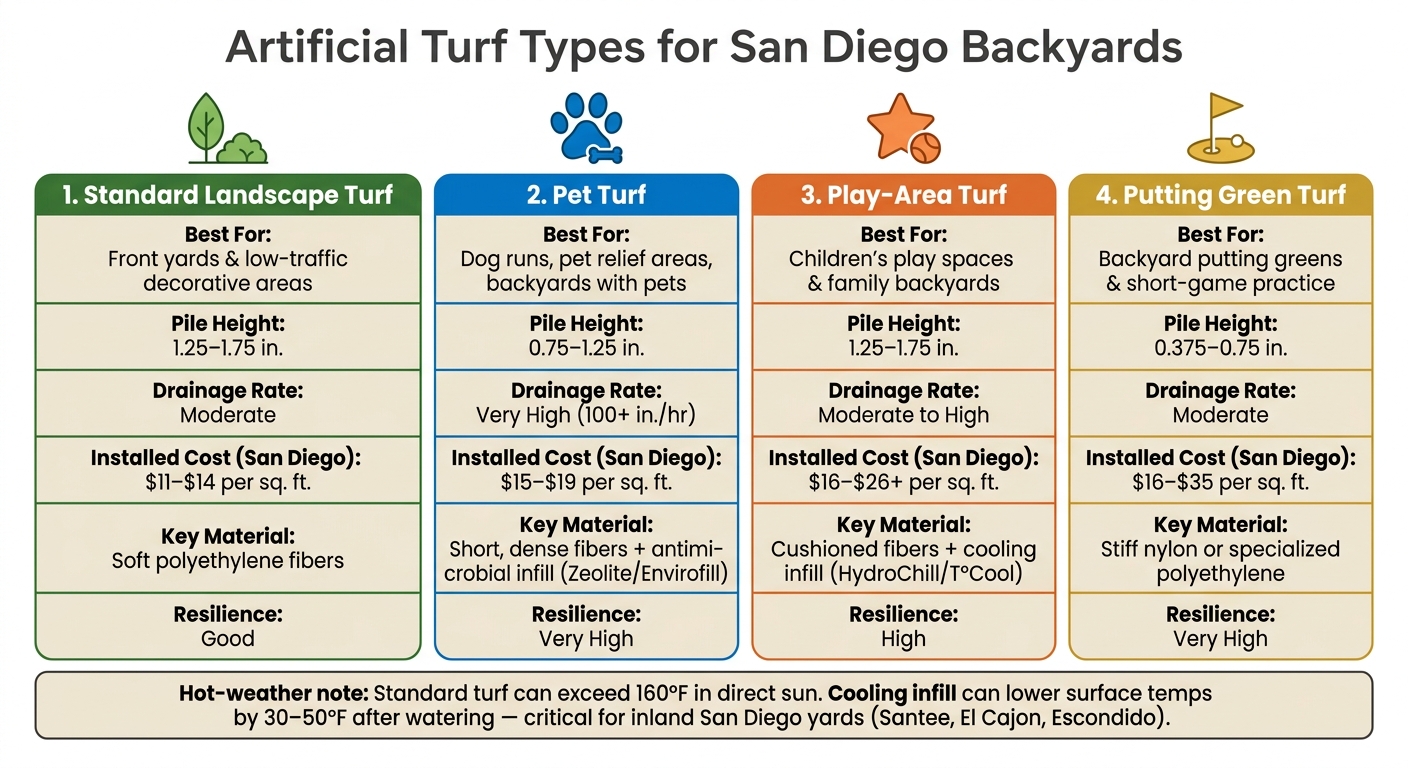
Artificial Turf Types for San Diego Backyards: Cost, Specs & Best Use
Start with the use case: landscape, pet, play-area, or putting green turf. That’s the simplest way to narrow your options. After that, compare density, fiber, infill, and drainage. The table below gives you a quick way to sort the main turf types before you look at the finer details.
Standard Landscape, Pet, Play-Area, and Putting Green Turf Explained
Standard landscape turf usually uses soft polyethylene fibers with a pile height of 1.25 to 1.75 in. It gives you the most natural-looking finish for general landscaping.
Pet turf has a shorter, denser pile, usually 0.75 to 1.25 in. That shorter build helps limit digging and makes cleanup easier. Good pet systems can drain 100+ inches per hour, which is about 10 times faster than standard turf. Antimicrobial infills like Zeolite or Envirofill can also help cut odors from pet waste.
Play-area turf is built around softness and wear resistance for frequent use. That matters in inland San Diego, where surface temperatures can go past 160°F. Cooling infills can bring that down by 30–50°F.
Putting green turf uses stiff nylon or specialized polyethylene with a very short pile of 0.375 to 0.75 in. Those short, stiff fibers help keep ball roll even.
| Turf Type | Softness | Typical Pile Height | Drainage | Resilience | Best Use Case |
|---|---|---|---|---|---|
| Standard landscape turf | Medium to high | 1.25 to 1.75 in. | Moderate | Good | Front yards and low-traffic decorative areas |
| Pet turf | Medium | 0.75 to 1.25 in. | Very high | Very high | Dog runs, pet relief areas, and backyards with frequent pet use |
| Play-area turf | High | 1.25 to 1.75 in. | Moderate to high | High | Children's play spaces and family backyards |
| Putting green turf | Low | 0.375 to 0.75 in. | Moderate | Very high | Backyard putting greens and short-game practice areas |
Material Features That Affect Turf Performance
Once you know the turf type, look at the material specs. This is where you start to see how a product will hold up over time, especially in San Diego’s sun and heat.
Face weight is measured in ounces per square yard, and it’s one of the clearest signs of density and expected life. Budget turf in the 40–55 oz/sq yd range often starts to thin within 2–3 years. Standard residential products usually land around 60–70 oz, while premium options come in at 70–90 oz.
Blade shape and yarn material matter too. Polyethylene is the usual choice for residential yards because it feels soft and looks natural. Polypropylene costs less, but it’s heat-sensitive and can melt or warp under San Diego sun. Nylon is the stiffest option, so it’s most often used for putting greens and commercial settings.
Infill does more than keep the blades standing up. Silica sand is the basic budget option. Antimicrobial-coated products like Envirofill or Zeolite are common for homes with pets. Evaporative cooling infills like HydroChill or T°Cool can help with heat in inland yards.
In inland full-sun yards, it’s smart to be a bit more cautious about lifespan and warranty expectations than lab ratings may suggest.
How to Match Turf to Your Yard's Sun, Traffic, Pets, and Drainage
Start with sun exposure. Coastal yards in La Jolla or Del Mar can usually use standard polyethylene. Inland yards in Santee, El Cajon, or Escondido should put more weight on UV-protected fibers and cooling infills.
Then match face weight to foot traffic. High-traffic yards should usually be in the 70–90 oz/sq yd range to help resist matting. Lower-face-weight turf can still work well in decorative areas that don’t get much use.
Drainage becomes a bigger deal in clay-heavy inland yards. The turf matters, but the base prep underneath matters just as much. Pet households need permeable backing. If the yard already has drainage problems, proper grading should happen first. A slope of about 1.5%–2.0% is typical before turf installation begins.
Mixed-use yards need a plan before materials are ordered. A backyard with pets, kids, and a seating area may need more than one turf style, or at least a product that can handle competing demands. Once the turf type is picked, the installation still has to fit the yard’s slope, drainage, and access.
Artificial Turf Installation: What to Expect and How to Plan for San Diego
What a Professional Turf Installation Includes
Once you’ve picked the turf, the next thing that matters is the install. That’s what shapes drainage, the final look, and how long the surface holds up.
A proper install includes excavation, base prep, grading, turf layout, seam bonding, perimeter fastening, and infill. In San Diego, some of those steps matter even more because site conditions can change from one neighborhood to the next. Clay-heavy inland soils often need deeper excavation than the usual 3–4 inches to avoid drainage trouble. Pet areas may need deeper excavation too.
The base is usually built with Class II road base compacted to 90%+ in lifts, and some jobs add decomposed granite on top. During base prep, installers also finish the grading so water moves away from the foundation. Seams are joined with tape and adhesive so the joints stay flush and hold up over time. Around the edges, the turf is fastened with 6-inch galvanized nails spaced every 4–6 inches. Then infill is spread and power-brushed in to finish the surface.
Most residential jobs wrap up in 1–3 days.
In San Diego, a good install isn’t just about the turf product. It also has to fit the local soil, water flow, and HOA rules.
San Diego Site Planning: Slopes, Drainage, Irrigation, and HOA Rules
In inland areas like El Cajon and Escondido, clay-heavy soils don’t drain well. One simple field check is to hose down the area after excavation. If water sits for more than 10 minutes, you may need deeper excavation or a drainage pipe. It’s a plain test, but it can save a lot of trouble later.
Existing irrigation lines should be capped or rerouted before base compaction starts. Any leaks need to be fixed first, or you risk soft spots and sinking after the turf goes in. In East County areas such as Santee and Ramona, gopher wire is often added during base prep.
Pre-install approval can matter too. In many communities, material specs and drainage plans need to be reviewed before work begins. California Civil Code §4735 limits HOA rules that ban artificial turf, but HOAs can still ask for approval tied to color, pile height, or install standards. Sending in your specs and drainage plan up front can help avoid delays. If the project ties drainage into public storm infrastructure, the City’s DS-560 Storm Water Requirements checklist may also be required.
If turf is part of a bigger backyard project, grading and finish heights should be planned from day one.
When Turf Works Best as Part of a Full Backyard Remodel
Turf tends to work best when grading, hardscape, and drainage are planned as one system. For example, when turf is installed next to pavers, the crew can adjust base depths so the finished surfaces meet the walkways cleanly - either flush or slightly proud. That helps cut down trip hazards and keeps water moving across the yard through one connected drainage setup.
The same idea applies to irrigation, retaining walls, pergolas, and outdoor kitchens. When those parts are planned together, the yard comes together more cleanly. There’s a cost angle too: shared grading, hauling, and equipment across one combined project can lower total cost.
Artificial Turf Costs in San Diego
Once you’ve picked the turf type and nailed down the install plan, the final price mostly comes down to prep work. In San Diego, turf costs hinge on three things: the product itself, the condition of the site, and how much ground work the job needs.
Typical Installed Cost Per Square Foot
For most San Diego homeowners, standard landscape turf costs $11.00–$14.00 per sq. ft. installed. If you need a pet setup with high-flow drainage backing and antimicrobial infill, expect $15.00–$19.00 per sq. ft. Putting greens cost more because they take tighter grading and shaping, usually $16.00–$35.00 per sq. ft. Premium cooling systems can push pricing to $21.00–$26.00+ per sq. ft., which shows up a lot in hotter inland yards.
| Cost Item | Range (San Diego 2026) |
|---|---|
| Standard installed turf | $11.00 – $14.00 per sq. ft. |
| Pet-ready installed turf | $15.00 – $19.00 per sq. ft. |
| Premium cooling / high-traffic | $21.00 – $26.00+ per sq. ft. |
| Putting green installed | $16.00 – $35.00 per sq. ft. |
| Turf material only | $2.00 – $7.00 per sq. ft. |
| Labor and basic installation | $4.00 – $10.00 per sq. ft. |
| Base materials (road base/DG) | $1.50 – $3.00 per sq. ft. |
| Drainage corrections | $35.00 – $55.00 per linear ft. |
| Edging or border work | $1.00 – $3.00 per linear ft. |
| Pet-friendly infill upgrade | $0.50 – $1.50 per sq. ft. |
| Demolition and haul-away | $1.00 – $3.00 per sq. ft. |
Those numbers can jump fast if the yard needs extra digging, drainage fixes, or tough access work. Ask for a line-item quote that breaks out demolition, base prep, turf, and infill. A one-line bid may look simple, but it often hides the full scope.
What Drives the Final Project Price
A few site details can swing the total in a big way. Soil type is a major one. Clay-heavy inland soils often need deeper excavation - sometimes 8–12 inches, compared with the 6–8-inch range that’s more common in sandy coastal areas. That means more labor and more base material.
Yard access also changes the math. If a narrow side gate keeps machinery out, the crew may have to move materials by wheelbarrow, which can add 10–20% to labor costs. Sloped yards are another cost driver. On steep grades, total project price can climb by as much as 50% because of hauling, drainage work, or even retaining walls.
Then there are the add-ons. Cooling infills like HydroChill or T°Cool cost $1.50–$2.50 per sq. ft. Antimicrobial infills for pet areas, such as Envirofill or Zeolite, add $1.00–$1.80 per sq. ft. If the yard drains poorly, French drains or catch basins usually run $35.00–$55.00 per linear foot.
United Turf & Pavers offers a free design consultation, which is often the fastest way to get a site-specific estimate before you lock in a budget.
Turf Maintenance, Backyard Design Ideas, and a Pre-Installation Checklist
After you’ve picked the turf and priced the job, the next step is simple: figure out how the space will be used, what upkeep looks like day to day, and what needs a final check before install day.
What Low-Maintenance Turf Care Actually Involves
Artificial turf doesn’t need much work, but it’s not a zero-care surface.
Most weeks, a leaf blower and a quick hose rinse are enough to deal with dust, leaves, and other debris. About once a month, brush the turf with a stiff-bristle broom to keep the blades standing up, especially in high-traffic areas and spots under patio furniture. Once a year, bring in a pro for grooming. That visit should include redistributing infill, power-brooming matted sections, and checking seams and infill levels during annual grooming.
If you have pets, keep an enzyme-based cleaner on hand, such as Urine Zero, to help with odor between rinses. In hot weather, cooling infills can lower surface temperature by 30–50°F after watering. In most cases, annual turf care costs about $50–$200 in supplies.
Best Ways to Use Turf in a San Diego Backyard
Once you know what upkeep involves, it’s easier to plan where turf makes the most sense.
Put turf in areas where it has a clear job to do, like pet runs, side yards, and pool edges. Pet spaces do best with high-permeability backing that drains at 30–100+ inches per hour, plus antimicrobial infill to help cut down on odor in warm weather. For play zones, add shock-absorbing pads under the turf to help soften falls.
Poolside sections and narrow side yards are also a good fit because they deal well with drainage and heavy foot traffic. If the backyard is set up for hanging out, combine turf with hardscape so each area has a purpose - lawn, dining, and lounge space.
Checklist: What to Confirm Before Installation Starts
Before installation begins, check the details that affect drainage, wear, and project approval.
| Checklist Item | What to Confirm |
|---|---|
| Turf specs | Face weight (60–90 oz for wear), pile height, yarn type (polyethylene is the standard choice for homes) |
| Drainage rate | Backing should drain 30–100+ inches per hour; base slope should be 1%–2% away from structures |
| Infill type | Cooling infill (HydroChill/T°Cool) for full-sun areas; antimicrobial (Envirofill/Zeolite) for pet zones |
| Edge finish | Confirm bender board, steel, or concrete mow strip to keep edges from lifting |
| Excavation depth | 3–4 inches is standard; 4+ inches for pet or high-traffic areas |
| Irrigation | Existing lines should be capped or the controller removed fully |
| Utilities and HOA | Underground lines marked before digging; HOA approval submitted and cleared |
| Gopher wire | Planned for East County yards |
| Bid format | A line-item bid that separates demolition, base materials, turf grade, and labor |
One step people often miss: after excavation, lightly hose down the exposed area. If water sits there for more than 10 minutes, the drainage plan needs to be fixed before the base is installed. It’s a lot easier to deal with that at this stage than after the turf is already down.
FAQs
How do I choose the right turf for my backyard?
Choose turf based on how the space gets used, who uses it, and where you live in San Diego.
For decorative spots or areas with light foot traffic, mid-density turf with a 50–65-ounce face weight gives you a natural-looking finish without going overboard.
If pets will use the area, focus on turf with high-drainage backing and antimicrobial infill. That combo helps with odor control and keeps the space cleaner.
In hotter inland parts of San Diego, premium cooling systems can cut surface temperatures by 30–50°F, which makes the turf much more comfortable underfoot.
Is artificial turf too hot for San Diego summers?
Artificial turf does get hotter than natural grass in San Diego’s summer sun. That’s the plain truth. But for most homeowners, it’s manageable rather than a dealbreaker.
Where you live makes a big difference. Coastal areas tend to stay cooler, while inland communities like Santee, El Cajon, and Escondido can see turf surface temperatures climb above 160°F during peak afternoon sun.
That’s why material choice matters. United Turf & Pavers uses premium cooling infill that can lower surface temperatures by 30°F to 50°F.
What should I check before turf installation starts?
Before work starts, make sure your contractor has checked drainage, soil type, and site access. Those details can shape the whole job, and skipping them early can lead to headaches later.
You’ll also want to confirm that any required HOA approvals are done ahead of time. In many cases, that process can take 30 to 45 days.
If you plan to use a rebate program, double-check that all approvals are fully cleared before installation begins. United Turf & Pavers can help assess drainage, plan grading, and handle gopher wire protection if your site needs it.