.webp)
.webp)

San Diego Putting Greens: DIY or Hire a Pro?
August 30, 2026
For most San Diego homeowners, DIY works best on flat, sandy yards, while a pro is the safer pick for slopes, clay soil, drainage trouble, or HOA-heavy projects.
Your main tradeoff is simple: pay less upfront with DIY but take on more labor, tool costs, grading risk, and rework risk. In San Diego, that matters more because inland clay soil can hold water for 48–72 hours, HOA reviews can take 30–45 days, and pro turf installation for 500–800 sq. ft. often costs about $7,500 to $12,000.
Before choosing, focus on these points:
- Cost: DIY turf may start at $1.29 to $6.50 per sq. ft., but that does not include base prep, rentals, haul-off, or drainage.
- Time: A pro crew often finishes in 1–3 days. DIY can stretch across multiple weekends.
- Soil: Coastal sandy yards are easier to build on. Inland clay yards usually need deeper excavation and better drainage.
- Drainage: A putting green needs proper slope and compaction, or ball roll and runoff can become a problem fast.
- Skill level: Cutting turf is only part of the job. Excavation, grading, cup setting, seaming, and infill all affect play.
- Rules: HOA approval and permit needs can slow the project if paperwork is skipped.
If your yard is simple, level, and drains well, DIY can make sense. If your yard has slope, clay, runoff issues, or is part of a bigger remodel, hiring a licensed San Diego contractor is usually the lower-risk path.
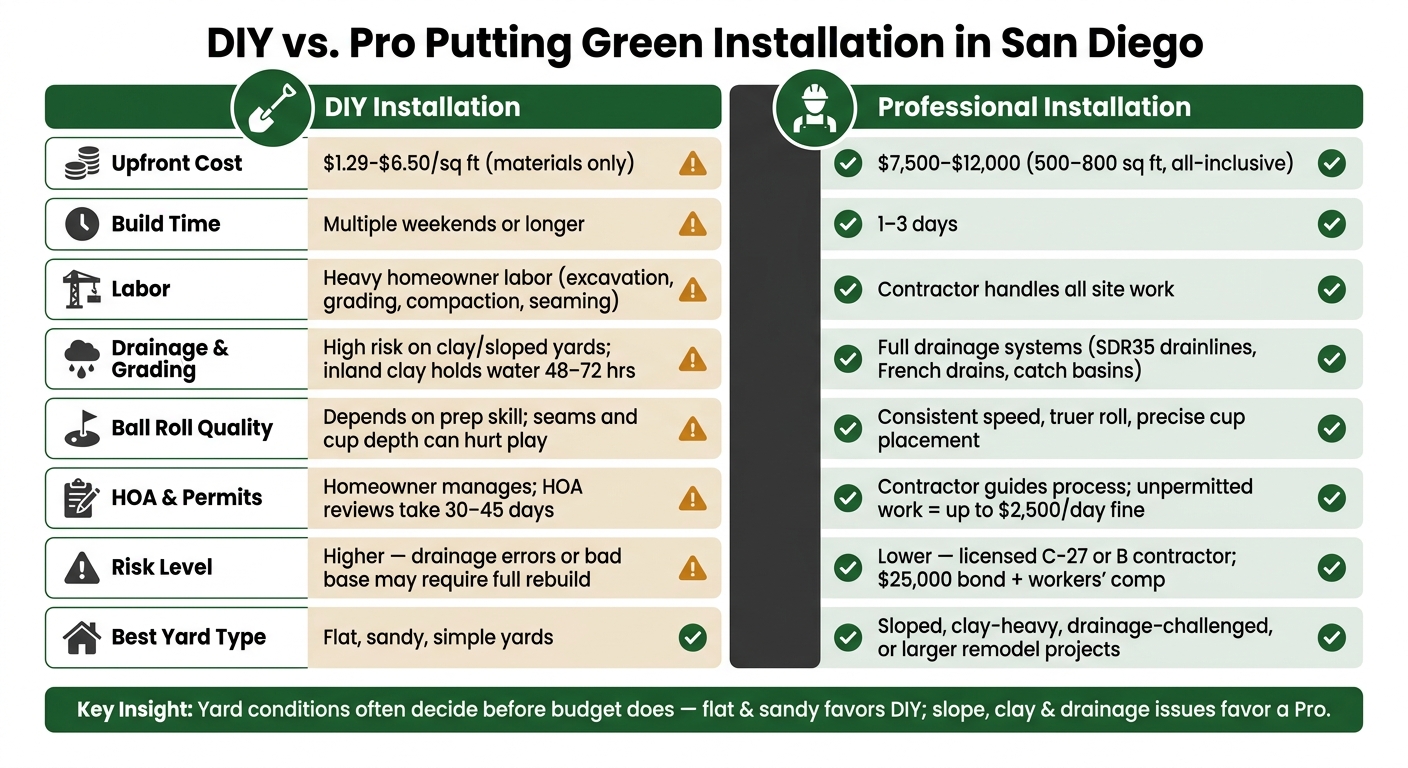
DIY vs. Pro Putting Green Installation in San Diego: Cost, Time & Risk
The Reality of Building a DIY Backyard Putting Green
sbb-itb-2b3b7d5
Quick Comparison
| Point | DIY putting green | Pro installation |
|---|---|---|
| Upfront price | Lower at first | Higher at first |
| Total cost risk | Can grow with rentals, drainage, and mistakes | More predictable |
| Build time | Multiple weekends or more | Often 1–3 days |
| Labor | Heavy homeowner labor | Contractor handles it |
| Drainage and grading | Harder to get right | Better handled on tough sites |
| Ball roll quality | Depends on prep skill | More consistent |
| HOA and permits | Homeowner handles it | Contractor may help guide HOA approval |
| Best yard type | Flat, sandy, simple yard | Sloped, clay-heavy, or mixed-use yard |
The rest of the article breaks down where DIY saves money, where it often goes wrong, and when a pro install is worth the added cost.
DIY Putting Greens: Lower Upfront Cost, Higher Demands
DIY is where things get tougher in San Diego. The margin for error is small, and drainage plus grading matter a lot more than many homeowners expect. Yes, doing it yourself can cut the upfront price. But a putting green still takes excavation, base prep, drainage, grading, seaming, cup placement, infill, and brushing. If even one of those steps is off, ball roll takes a hit.
| DIY factor | Potential advantage | Main drawback |
|---|---|---|
| Upfront cost | Lower material-only cost than full-service installation | Savings can shrink after tool rental, base material delivery, and waste |
| Schedule control | Work can be done on your own weekends | Projects often stretch across multiple weekends |
| Design control | Full control over shape and layout | Harder to build contours that still roll true |
| Labor | No installer labor charge | Heavy excavation, hauling, grading, and compaction work |
| Drainage | Possible on simple, flat sites | Higher risk of pooling or runoff if grading is off |
| Ball roll quality | Can be good with precise prep | Uneven base, visible seams, and poor cup depth can hurt playability |
| Repair risk | Small fixes can be handled personally | Larger mistakes may require partial rebuilds that erase savings |
DIY Steps, Tools, and Material Costs
The process starts with excavation. After that, you build and compact a crushed aggregate or decomposed granite base, then grade it so water drains the right way. The surface should have a 2–5% slope - about 1/4 inch of drop per foot - so water moves off the green instead of sitting on it.
Next comes the finish work. You install poly board edging around the perimeter, cut and place the performance turf, and set cups at exact depths before joining panels with adhesive. Once the turf is locked in, you spread silica sand infill and power-brush it into the fibers. That step helps shape the green's speed and playing direction.
This is also where costs can snowball. Turf materials alone range from $1.29 to $6.50 per sq. ft.. If you need clay soil haul-off, add $50 to $70 per cubic yard. Drainage systems can cost $35 to $55 per linear foot. Stack those line items together, and the price gap between DIY and pro install can shrink fast.
Where DIY Putting Green Projects Go Wrong
The base is the weak spot most often. If compaction isn't tight and even, the surface can shift over time. And you won't need a measuring tape to notice it - you'll feel it in the roll of every putt.
Poor grading is the next big problem. A small low spot may not look like much during install, but after rain, it can hold water. In San Diego's clay-heavy inland neighborhoods, that water can sit for 48–72 hours.
"Drainage went in first - 270 linear feet of 3-inch SDR35 - because everything else gets ruined if it isn't right." - Install-It-Direct
Seams also trip people up. Putting green turf panels need to meet cleanly and stay hard to spot. If a seam shows, it doesn't just hurt the look of the green. It can change ball roll across the surface. Cup depth matters too. If a cup is too shallow or just slightly off-angle, the hole won't play right, and the whole green can feel homemade in the bad sense of the word.
The money risk is hard to ignore. A bad base or drainage error often means pulling up turf and doing the job again, which can wipe out labor savings. DIY tends to work best on flat, sandy sites when the owner has the right tools and some construction know-how. On sloped lots, clay-heavy soil, or sites with drainage trouble, pro installation starts to look like the safer bet.
Hiring a Pro: Better Finish, Faster Completion, More Reliable Results
If your yard has a slope, heavy clay, or drainage issues, hiring a pro is usually the cleaner, lower-risk move. A good crew handles the site work, base, drainage, and finish correctly from the start. When a DIY project runs into trouble at grading or runoff control, pro installation deals with those issues before the turf goes down.
The tradeoff is pretty simple: you spend more upfront, but you get less guesswork and a much faster build.
| Professional installation factor | What homeowners can expect |
|---|---|
| Upfront cost | Higher upfront cost than DIY; labor, equipment, base prep, and finish work are included |
| Project duration | Usually finished in days, not weekends |
| Design customization | More accurate shaping, contouring, and cup placement |
| Site evaluation and drainage | Full assessment of slope, soil, and drainage paths with reliable grading and runoff control |
| Seams, finish, and ball roll | Cleaner cuts, tighter seams, and more predictable speed and truer roll |
| Warranty | May include workmanship and material warranties |
What Professional Putting Green Installation Includes
A crew usually starts by checking the slope, drainage, soil, and site access before deciding how to build the green as part of a backyard remodeling plan. Then they match the base, drainage plan, and cup layout to the yard itself. After that comes the finish work: tight seams, even infill, and a surface that gives a truer roll.
What sets pro work apart is the equipment and site prep behind it. That includes machine compaction, built-in drainage systems such as SDR35 drainlines, French drains, and catch basins, plus precise seam work and accurate cup placement. That prep work is often the line between a green that plays well right away and one that needs repairs later.
Why Working With a Licensed San Diego Contractor Matters
Licensing is not just paperwork. In California, a contractor needs an active C-27 (Landscaping) or B (General Building) license through the Contractors State License Board (CSLB) to legally do this kind of work. There’s also a plain financial reason to care: California homeowners can be held liable if an unlicensed worker gets hurt on their property. Licensed contractors must carry workers' compensation and at least a $25,000 bond.
Local experience matters too. Contractors who know San Diego neighborhoods are often better prepared for HOA architectural reviews, which can take 30–45 days, and they know when city permits are needed for grading or drainage work. Skipping permits can get expensive fast. In San Diego, unpermitted work can lead to civil fines of up to $2,500 per day, per violation.
United Turf & Pavers is a licensed San Diego contractor that installs putting greens and related backyard features.
DIY vs. Pro in San Diego: Cost, Time, and Long-Term Value Compared
The full cost is what matters. Turf price by itself doesn't tell you much. Once you get into labor, drainage, and cleanup, the gap between DIY and pro work gets smaller than it first appears. DIY turf materials usually run $1.29–$6.50 per square foot, but that number leaves out base prep, equipment rentals, and debris removal.
Here’s how the two paths stack up in San Diego.
| Comparison point | DIY putting green | Professional installation |
|---|---|---|
| Approximate cost per sq ft | Lower material cost, but total climbs with base prep, rentals, and disposal | Higher installed cost; labor and installation are included |
| Timeline | Often multiple weekends or longer | Usually completed in days |
| Tools and skill required | High; requires excavation, grading, compaction, cutting, and seaming ability | Minimal homeowner labor; contractor handles excavation, grading, and seaming |
Cost and Time Breakdown for Common Backyard Green Sizes
On paper, a small DIY backyard putting green can look like the cheaper move. Then the add-ons start piling up: plate compactor rental, sod cutter rental, crushed rock base, weed barrier, and hauling fees for removed soil. You can burn through a budget fast before the first piece of turf is even set in place.
In San Diego, soil disposal and fill alone can cost $50–$70 per cubic yard. That’s one of those line items people tend to miss at the start.
For small to medium yards - about 500–800 sq ft - professional installs usually land between $7,500 and $12,000. Time is another big split. A pro crew can usually finish a standard residential green in 1–3 days. A DIY build of the same size often spills into multiple weekends, and sometimes longer.
When a Pro Is the Better Fit
A pro is often the safer bet when the site itself can affect drainage or how the green plays. If the yard has slope, clay soil, or drainage issues, mistakes can lead to rework. And that gets expensive fast.
Drainage fixes added later - such as French drains or catch basins - usually run $35–$55 per linear foot. At that point, the money saved by going DIY can disappear in a hurry.
If the putting green is part of a bigger yard project, there’s also a timing advantage. Having grading and installation handled together can cut down on delays and help avoid doing the same work twice.
Conclusion: Choosing Between DIY and Pro Comes Down to Budget, Risk, and Yard Conditions
Once you stack up cost, time, and site conditions, this choice usually comes down to risk.
DIY can cut the upfront price. But that only works if you can take on artificial turf installation steps like excavation, grading, and seam work without messing up drainage or ball roll. If any of those pieces go sideways, the "cheaper" route can get expensive fast.
In many cases, yard conditions make the call before budget does. Flat, sandy yards are usually the easiest fit for DIY. Clay-heavy inland lots are a different story. Those often need pro drainage and grading to avoid water problems and uneven play.
Professional turf installation gives you a playable surface from day one. And for bigger remodels, there's another plus: one licensed contractor can manage grading, turf, and hardscape work together, so the yard doesn't get dug up twice. This is the setup United Turf & Pavers runs on most of its larger jobs — putting greens, drainage grading, and broader backyard remodels handled as one project instead of three separate hires. That helps keep the job moving and cuts down on rework.
Best fit: DIY for simple, forgiving yards; pro installation for slopes, clay, drainage issues, or larger remodels.
FAQs
How do I know if my yard is DIY-friendly?
A yard project is usually DIY-friendly when the job is small and simple. Think filling minor low spots, extending downspouts, or adding basic channel drains without major digging.
But once the work involves grading, structural work, major drainage, or utility connections, it’s usually smarter to call a professional. That can help you avoid drainage problems, code issues, and expensive repairs.
What hidden DIY costs catch homeowners off guard?
DIY putting greens often cost more than people expect, and site prep is usually the main reason.
Grading, rock removal, drainage work, and deeper base layers for tricky soil can push the budget up fast. If your property has failing pipes or tight access, costs can climb even more because delivery and debris removal get harder. In many cases, those issues add 10% to 20% to the total.
Permit problems can hit even harder. They can lead to daily fines, forced demolition, and even resale headaches later on.
Then there are the changes that happen mid-project. Upgrading to better turf, adding lighting, or making other add-ons can quietly stretch the budget. That’s why setting aside a 10% to 15% contingency isn’t just smart - it helps you avoid getting blindsided.
Will I need HOA approval or permits first?
Often, yes. In San Diego, backyard improvements may need HOA approval even when a city permit isn't required.
That’s because HOA ARC review is separate from city permitting. So before you make plans, check your community’s CC&Rs. Reviews often take 30–60 days, and applying early can help you avoid delays.