.webp)
.webp)

Paver Border Styles vs Full Patio Patterns for San Diego Homes
September 13, 2026
For most San Diego homes, borders work best when your patio needs clear zones. A full pattern works best when your yard is small, irregular, or budget-driven.
Your choice affects cost, install time, yard fit, and how dining, lounge, and walkway areas read at a glance. In San Diego, paver patio installation often runs $20 to $35 per square foot, while added border detail can add about $2 to $6 more per square foot and stretch a 2- to 3-day install on a 400- to 800-square-foot patio.
Before starting your San Diego backyard remodeling project, focus on these points:
- Borders frame edges and split up use areas, which matters when designing an outdoor kitchen
- Full field patterns keep the surface cleaner and less busy
- Simple patterns cost less labor than layouts with many cuts
- Large, straight yards handle borders better
- Small or uneven lots often look better with one pattern across the patio
- Artificial turf, gravel, drainage and grading, and retaining walls can shape where borders make sense
- Base prep matters too, especially on inland clay-heavy lots that m
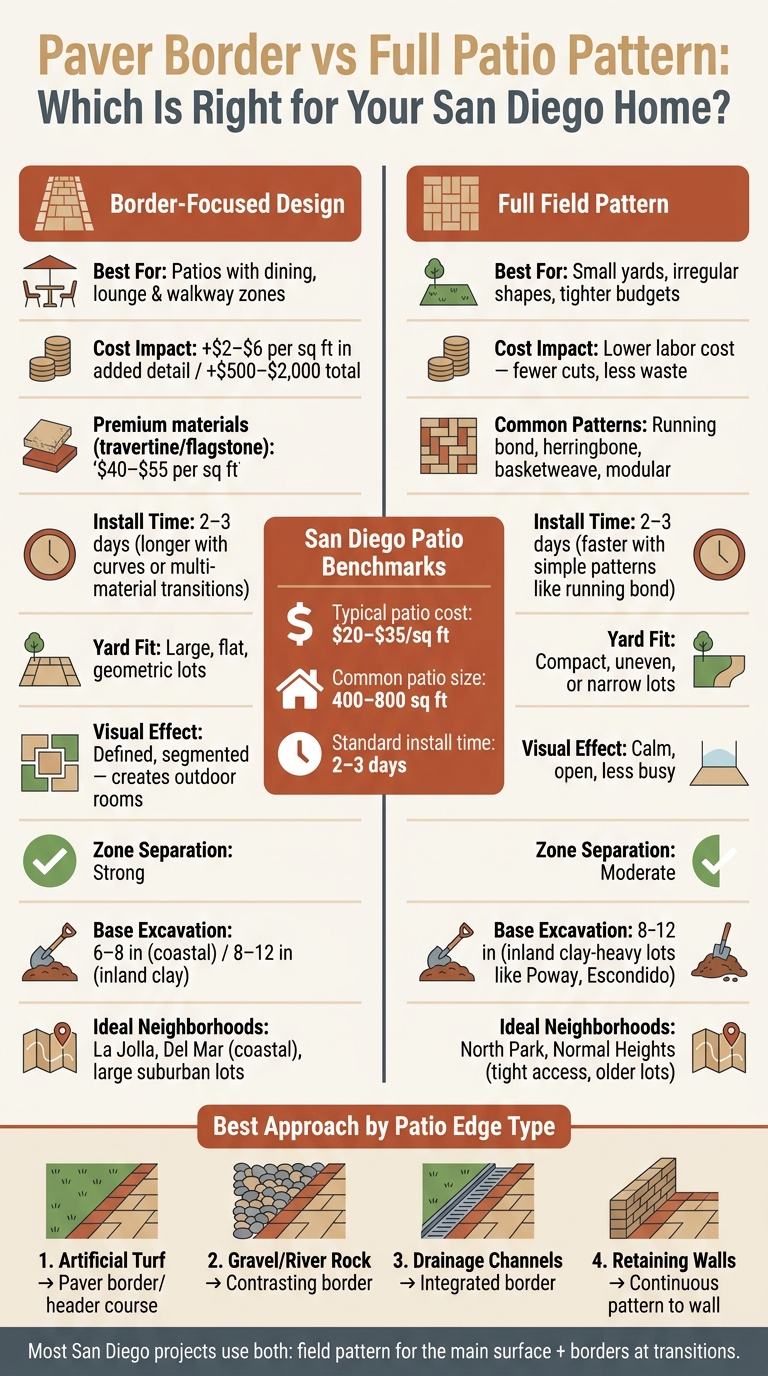
Paver Border vs Full Patio Pattern: San Diego Cost & Fit Guide
Should I install a border or banding on my paver patio?
sbb-itb-2b3b7d5
Quick Comparison
| Option | Best For | Cost Impact | Visual Effect | Yard Fit | Use Zones |
|---|---|---|---|---|---|
| Border-focused design | Patios with dining, lounge, and walkway splits | Higher due to more cuts and detail | More defined and segmented | Best on large, straight layouts | Strong zone separation |
| Full patio pattern | Smaller yards, odd shapes, tighter budgets | Often lower labor cost | Cleaner and calmer | Best on compact or uneven lots | Less visual separation, more open feel |
In short, if your yard needs clear separation, borders usually make more sense. If your goal is a simpler layout, lower labor, and a more open look, a full patio pattern is often the better pick.
What Paver Borders and Full Patio Patterns Do
Borders frame the edges. Field patterns shape the main surface.
Border Styles That Frame and Separate Spaces
A paver border runs along the outside edge of a patio or cuts through the patio as an interior band. Its main job is simple: frame the space and show where one zone ends and another begins. Common border treatments include contrasting bands and decorative inlays.
But borders aren't just there to look good. They also do practical work. A border can mark the shift between a patio and artificial turf installation or planting beds. It can separate a dining area from a lounge space without needing a wall or divider. And when permeable materials are used, borders can also help manage runoff.
That framing job matters even more when the patio meets turf, planting beds, or other hardscape edges.
Field Patterns That Shape the Main Surface
The field pattern covers most of the patio, so it has a big effect on how the space feels. It sets the overall visual tone. Some patterns make the area feel calm and open. Others add more movement and energy.
The most common field patterns in San Diego include running bond, herringbone, basketweave, and modular layouts that mix paver sizes for a less uniform look. Custom layouts take longer to install.
| Feature | Border Styles | Field Patterns |
|---|---|---|
| Primary role | Frames edges, marks transitions, defines zones | Shapes the main surface and controls visual flow |
| Common styles | Contrasting bands, decorative accents, inlays | Running bond, herringbone, basketweave, modular |
| Cost impact | Adds detail; premium materials can raise cost | Simple patterns reduce labor; complex layouts increase it |
| Visual effect | Creates outdoor rooms and separates spaces | Determines whether the patio feels calm or busy |
Those two roles lead straight into the cost and layout tradeoffs that matter next.
Borders vs Full Patterns: Cost, Visual Impact, and Layout Limits
Borders add detail. Full field patterns usually make the job easier on budget, install time, and layout. Once you know what the patio needs to do visually, the next question is simple: does the yard shape support that choice?
How Borders Affect Cost and Installation Time
Decorative borders, contrasting inlays, and curved accents almost always push costs up. The reason is pretty straightforward: more cuts mean more labor, more time, and more waste.
In most cases, added detailing increases cost by about $2 to $6 per square foot, or roughly $500 to $2,000 on a typical patio. If the design leans heavily on borders, that total climbs from there. And if you move into premium materials like travertine or flagstone, pricing can hit $40 to $55 per square foot.
Installation time shifts too. A patio in the 400 to 800 square foot range usually takes 2 to 3 days to install. More border work can slow that down, especially when the layout includes curves or multiple material transitions.
That price difference stands out most when the yard itself doesn't leave much room for layout changes or extra cuts.
When a Full Field Pattern Is Simpler and More Practical
In yards with narrow side access, simple field patterns often make more sense. That's a common issue in older San Diego neighborhoods like North Park and Normal Heights, where getting materials and equipment into the backyard can already be a bit of a squeeze.
A full field pattern keeps things simpler. Running bond is one of the most cost-friendly options because it cuts down on waste and doesn't demand as many precision cuts. Put plainly, it's easier to lay out, easier to install, and often easier on the budget.
Which Option Fits Small, Large, Straight, or Irregular Lots
Lot size and shape have a big say here. A layout that looks great on a large rectangular yard can feel crowded on a small or uneven lot.
Here's how each option tends to fit common San Diego yard types:
| Yard Type | Better Fit | Why |
|---|---|---|
| Large, flat, geometric | Border-focused design | Borders help create clear zones and strong visual definition |
| Small, compact, or irregular | Full field pattern | Keeps the space from feeling busy or cluttered, and simpler to install |
| Clay-heavy inland lots (e.g., Poway, Escondido) | Full field pattern | Deeper excavation is needed - 8 to 12 inches - so the budget usually goes to base prep first; a simpler field pattern keeps overall costs in check |
| Coastal, flat lot (e.g., La Jolla, Del Mar) | Either approach | Sandy soil usually allows shallower base prep of 6 to 8 inches |
Those limits don't just affect installation. They also shape how borders and patterns carve out dining areas, lounge space, and walkways.
Using Borders or Patterns to Define Dining, Lounge, and Walkway Areas
Once cost and lot shape are clear, the next step is deciding how the patio should handle seating and foot traffic.
Where Borders Create Clearer Outdoor Rooms
Borders can make a patio feel like it has separate outdoor rooms. A darker band or double course can mark off a dining area, fire pit lounge, or walkway before you even set out the furniture. On open lots, that kind of visual edge helps divide dining and lounge space without putting up walls.
If you're using a border around a dining area, leave enough room for chairs to pull out without crossing the transition line. If the layout is too tight, the space can feel squeezed and may create a tripping issue.
If the yard already has strong structure, a simpler field pattern can handle the zoning on its own.
When Continuous Patterns Keep the Yard Calmer
If walls, planters, or turf already shape the yard, a continuous field pattern usually keeps the surface calmer and more flexible. It also makes it easier to move furniture around later and avoids extra visual breaks. This works best when the patio edge is already set by turf, gravel, drains, or a wall.
Transitions to Turf, Gravel, Drains, and Retaining Walls
Borders tend to work best where the patio meets another material. At the edge of synthetic grass, a paver border creates a clean line and helps keep the base from shifting. Where the patio meets gravel or river rock, a contrasting border holds loose stone in place and adds a visual break between materials. Around drainage channels, an integrated border can hide a surface drain while guiding runoff away from the foundation. If the patio runs into a retaining wall, the wall already acts as the edge, so carrying the field pattern straight to the wall usually keeps the install cleaner.
| Transition Type | Recommended Approach | Benefit |
|---|---|---|
| Artificial Turf | Paver border / header course | Creates a clean edge; prevents base migration |
| Gravel / River Rock | Contrasting border | Contains loose stone; adds visual texture |
| Drainage Channels | Integrated border | Conceals surface drains; directs runoff |
| Retaining Walls | Continuous pattern to wall | Uses the wall as the natural edge; simplifies install |
How to Choose the Right Approach for Your San Diego Home
Once you’ve looked at cost and layout limits, the choice mostly comes down to how you want the patio to work day to day. In most cases, the decision is between using borders to define parts of the space or using one full field pattern across the whole patio.
Your budget matters. So does the shape of the lot. And just as important, think about whether you need the patio to clearly separate different use areas.
When to Choose a Border-Focused Design
Go with borders when the patio needs clear, easy-to-read zones. Maybe you want one area for dining, another for lounging, and a path that connects them. Borders help mark those spaces without putting up physical dividers, which is often a smart move in a backyard where every foot counts.
They also make sense where the patio meets:
- turf
- walls
- built-in features
Those edges already act like natural stopping points, so a border can make the layout feel more intentional.
If your yard doesn’t need that kind of separation, a simpler field pattern usually makes more sense.
When to Choose a Pattern-Focused Design
Choose a continuous field pattern when the yard is small, irregularly shaped, or working within a tighter budget. Patterns like running bond or herringbone are often easier to install, which can help keep labor costs down and shorten the timeline.
This approach also works well when the structure of the yard is already clear. For example, if walls or turf edges already define the space, a continuous surface can keep the patio looking calm and clean without adding more visual breaks.
Planning the Full Remodel as One System
Most San Diego backyard projects end up using both approaches: a field pattern for the main patio surface, plus borders where the hardscape meets turf or a retaining wall.
That’s why it helps to plan the whole remodel as one connected system from the start. Borders, field pattern, and transitions should all be mapped together. Other site details affect this too, including utility lines for fire pits or outdoor kitchens, drainage grading, and pergola post placement. Those elements can change where borders should run and how the field pattern fits the space.
Utility lines for fire pits or outdoor kitchens, drainage grading, and pergola post placements all affect where borders can run and how the field pattern lays out.
Working through those details early helps avoid duplicate trenching and keeps the finished surface looking consistent.
The strongest layouts usually happen when the border, field pattern, and site transitions are drawn as one plan instead of three separate ideas.
Conclusion: Building the Patio as Part of a Larger System
Border-focused or full-pattern, the right call for a San Diego patio comes down to lot shape, budget, and the number of zones the space needs. Neither option wins by default. A yard needing visual separation calls for borders. A yard needing a calmer, uninterrupted surface calls for a full pattern.
That decision rarely happens on its own. Most paver patio projects run into drainage, turf transitions, or a retaining wall before the job wraps. Plan those pieces together, not layout by layout. That's what keeps the finished patio reading as one space instead of parts stitched together later.
This is the approach United Turf & Pavers takes on most backyard remodeling projects in San Diego: pattern, borders, and transitions get mapped alongside drainage and turf from day one, not added after the surface is already down.
FAQs
Should I combine a border with a full patio pattern?
Yes. Pairing a border with a full patio pattern is often a smart move for San Diego homeowners.
A simple field pattern can look great on its own. But a decorative border does more to define the space. It helps separate dining, lounge, and walkway areas, so the patio feels more planned and easier to use.
Borders can help on the practical side too. With permeable pavers, they may help direct runoff where it needs to go.
It’s also usually more efficient to add these details during the first remodel instead of changing the layout later.
Which paver pattern best hides cuts and irregular edges?
Complex, irregular patterns tend to hide cuts and uneven edges better. Random or modular layouts pull the eye toward the mix of shapes and sizes, so single cuts don’t stand out as much.
Simple patterns like running bond or herringbone can save money, but their clean, repeated lines often make cuts more obvious.
Do borders make sense if my patio connects to turf or gravel?
Yes. A paver border creates a clean, intentional transition between the patio and turf or gravel. It helps keep gravel off the patio and keeps turf edges neat.
It also defines the space and gives the whole design a more polished look.