.webp)
.webp)

What Fits in a Small San Diego Backyard Remodel
July 15, 2026
A small San Diego backyard usually fits one main zone well and a few support features around it.
If your yard is tight, the best setup is often a small patio, built-in seating, some form of shade, and either a small turf area or a compact fire feature. In most cases, you need to keep at least 3 feet of walking space, plan for local soil and drainage, and check HOA or permit rules before adding structures.
Here’s the short answer for what often fits:
- Patio: about 120 to 250 sq ft
- Dining setup: small table and chairs near the house
- Seating: built-in bench or seat wall to save room
- Shade: often a 10x12 pergola, awning, or shade sail
- Fire feature: low-profile gas fire table or bowl
- Turf: often 300 to 800 sq ft if open play space matters
- Drainage and lighting: slim drains, proper slope, and low-voltage lines planned early
Your layout will usually depend on one main goal:
- Hosting: more patio and seating
- Kids or pets: more turf and open space
- Easy upkeep: more hardscape, less planting
| Layout | Best Use | Main Features | Main Trade-Off |
|---|---|---|---|
| Entertaining Core | Small gatherings | Patio, bench, pergola, fire bowl | Less open yard |
| Family Zone | Kids and pets | Turf area, small patio, containers | Less room for lounge features |
| Low-Upkeep Retreat | Clean, simple yard | Pavers, small turf accent, drainage, lighting | Less soft green space |
San Diego’s 266 sunny days per year, coastal moisture, inland heat, soil type, and HOA review all shape what makes sense in a small yard. The rest of the article breaks down how those limits affect patio size, seating, shade, turf, planting, and drainage so your space stays useful without feeling cramped.
14 Small Backyard Design Secrets
sbb-itb-2b3b7d5
Start With the Basics: Patio, Seating, and Circulation
The patio sets the footprint for a small backyard. Once that footprint is locked in, the next job is fitting seating and movement into the space without making the yard feel cramped.
A small patio doesn't have to be big to do its job well. A dedicated dining area usually needs 120 to 180 square feet, while a general-use paver patio often lands between 150 and 250 square feet. That gives you enough room for a table, a few chairs, and a clear path back to the house. Large-format pavers laid on a diagonal can make a tight patio feel a bit wider. Light-colored stone or concrete helps too, since it reflects natural light and keeps the area from feeling boxed in.
Compact Patios and Small Paver Dining Areas
In yards under 150 square feet, it makes sense to choose one main use and build around it. A small bistro-style dining setup is often a good fit in a narrow paver area close to the house. Placing the patio near the property line can cut down on wasted side space and leave more open room in the center of the yard.
If grilling is part of the plan, keep the grill station close to the house. Running gas or electrical lines farther out can add cost fast, and in a small yard, that extra spend usually doesn't give much back.
Circulation is where most small patio layouts fail. Even a nice-looking layout falls apart if people can't move through it without bumping into chairs or squeezing past a table. Plan for at least 3 feet of clearance on walking paths between the house, the dining area, and any other zones. If someone has to turn sideways to get by, the layout needs work before construction starts.
Once the patio shape is set, seating becomes the next big space-saving call.
Built-In Bench Seating Takes Up Less Room Than Loose Furniture
Freestanding chairs and sofas use up space fast - not just where they sit, but in the room needed around them. Built-in benches help by lining the patio edges, which keeps the middle of the yard open.
Built-in benches along one or two sides of the patio can seat six to eight people while using much less space than loose chairs. In coastal areas, use corrosion-resistant hardware and framing to deal with salt air.
Here's how the main seating options stack up in a small San Diego yard:
| Feature | Freestanding Furniture | Built-In Benches | Seat Walls |
|---|---|---|---|
| Space Efficiency | Low - needs clearance around legs and movement | High - uses perimeter space and removes dead zones | High - doubles as retaining wall and seating |
| Flexibility | High - can be rearranged or stored as needed | Low - permanent structure | Low - permanent structure |
| Maintenance | High - requires cleaning, moving, and cushion storage | Low - permanent materials like stone or wood | Very Low - typically masonry or concrete |
| Best For | Flexible group sizes | Tight corners with fixed seating needs | Casual overflow seating |
On sloped lots, an 18- to 24-inch retaining wall can double as seating without taking up extra room.
Add Shade and Focal Features Without Crowding the Yard
Once the patio and seating are in place, shade is the next feature worth making room for. In a small San Diego yard, shade isn't optional. The trick is fitting it in, along with a focal point like a fire feature, without turning the yard into an obstacle course.
Narrow Pergolas and Shade Structures That Fit Small Lots
A 10x12-foot pergola is a solid starting point for many small San Diego backyards. It can cover a dining setup or a lounge area without taking over the whole yard. To keep movement easy, leave at least 4 feet around the structure.
If the yard is tighter than that, retractable awnings or shade sails often make more sense. They give you coverage when you want it, then pull back when you don't. That helps the space stay open instead of boxed in.
Near the coast, the material choice matters more than many homeowners expect. In places like Pacific Beach or La Jolla, powder-coated aluminum is often the better fit because it holds up to salt air better than wood. Wood pergolas need resealing every two to three years.
Pergolas under 300 square feet are often permit-exempt in the City of San Diego, but Coastal Zone rules or electrical work can still trigger a review.
Small Fire Features for Compact Entertaining Areas
If you still have room after adding shade, a compact fire feature can stretch the yard's use into the evening. In a small space, fire tables and fire bowls tend to work best because they stay low and keep sightlines open.
Gas is the standard choice in San Diego. It creates no smoke or ash, and in some places, it's the only workable route because of wood-burning limits. Many HOAs and high-fire-risk zones restrict wood-burning. Gas fire features should stay 10 feet from combustibles.
"A massive stone fireplace might overwhelm a small yard, but a fire table is perfect. When the fire is lit, it's ambiance and warmth. When it's off, you can put the cover on, and it serves as a coffee table." - Andrew Larkin, Larkin Landscape
Pergolas make the yard more usable during the day. Fire features make it more usable at night. Put both into one small yard, and you get more function - but also less open space.
That pairing can work, though spacing has to be tight and intentional. Built-in seating tied into pergola posts or nearby planter walls helps support both areas without taking up extra floor space.
After shade and fire, the remaining square footage should go to turf, planting, drainage, and lighting.
Use Turf, Planting, Drainage, and Lighting to Get More From the Yard
Once shade and fire features are locked in, the rest of the yard needs to earn its keep. Turf, planting, drainage, and lighting should make the space more useful without chewing up square footage.
Artificial Turf Zones for Kids, Pets, and Low-Water Green Space
After the hardscape and shade structure are set, turf usually fits into the remaining open area. On small San Diego lots in the 2,500–4,000 sq ft range, a practical turf zone often lands between 300 and 800 sq ft. That's enough space for a kid-friendly play area or a set pet run without letting grass take over the whole yard.
A 400 sq ft rectangular play pad tends to fit well in a tight layout. If the goal is pet use, a narrow side-yard strip can do the job and leave the main patio open for seating and entertaining. Another smart move is a mixed layout, where turf and pavers are split by a thin gravel band. It looks polished, and it also makes both surfaces easier to maintain.
In inland spots like Santee or El Cajon, turf can get HOT in full sun. That's why cooling infill and drainage matter. Premium cooling turf systems cost about $21–$26 per sq ft installed, standard turf runs $11–$14 per sq ft, and pet-friendly systems with antimicrobial infill usually fall between $15–$19 per sq ft.
There’s also the water side of the equation. Replacing 1,000 sq ft of lawn with artificial turf can cut water use by about 55,000 to 60,000 gallons per year, which carries more weight now that San Diego water rates are up 14.7% as of January 1, 2026.
From there, the goal is simple: keep the edges useful with planting, drainage, and lighting that don't eat into the main floor area.
Container Planting, Slim Drainage, and Low-Voltage Lighting
Whatever space is left should stay open, drain cleanly, and light without a lot of hassle. In a small yard, ground-level planting beds can take up more room than they give back. Containers and vertical planting fix that by adding greenery while keeping the floor open.
A fence line with climbing Bougainvillea or trailing Rosemary brings in color without stealing patio space. Vertical garden panels can add about 30 sq ft of planting area with no ground footprint at all. That's a handy way to soften walls or fences when every foot counts.
Built-in planters set at 18–24 inches high can do double duty. They shape the yard's edges and work as casual seating, which can cut down on the need for extra chairs or benches. For San Diego's fast-draining sandy loam, mixing 2 inches of compost into the top 8 inches of soil helps plants get established with much less water.
Drainage needs the same space-saving mindset. Slim French drains or gravel drain strips at the base of retaining walls can handle runoff without bulky systems, and they usually cost about $35–$55 per linear foot installed. Paved areas should be graded 1.5% to 2% so water doesn't sit and pool. It also helps to install PVC sleeves under pavers during construction, so low-voltage lighting can be added later without tearing up the hardscape.
Small Backyard Layout Combinations That Work in San Diego
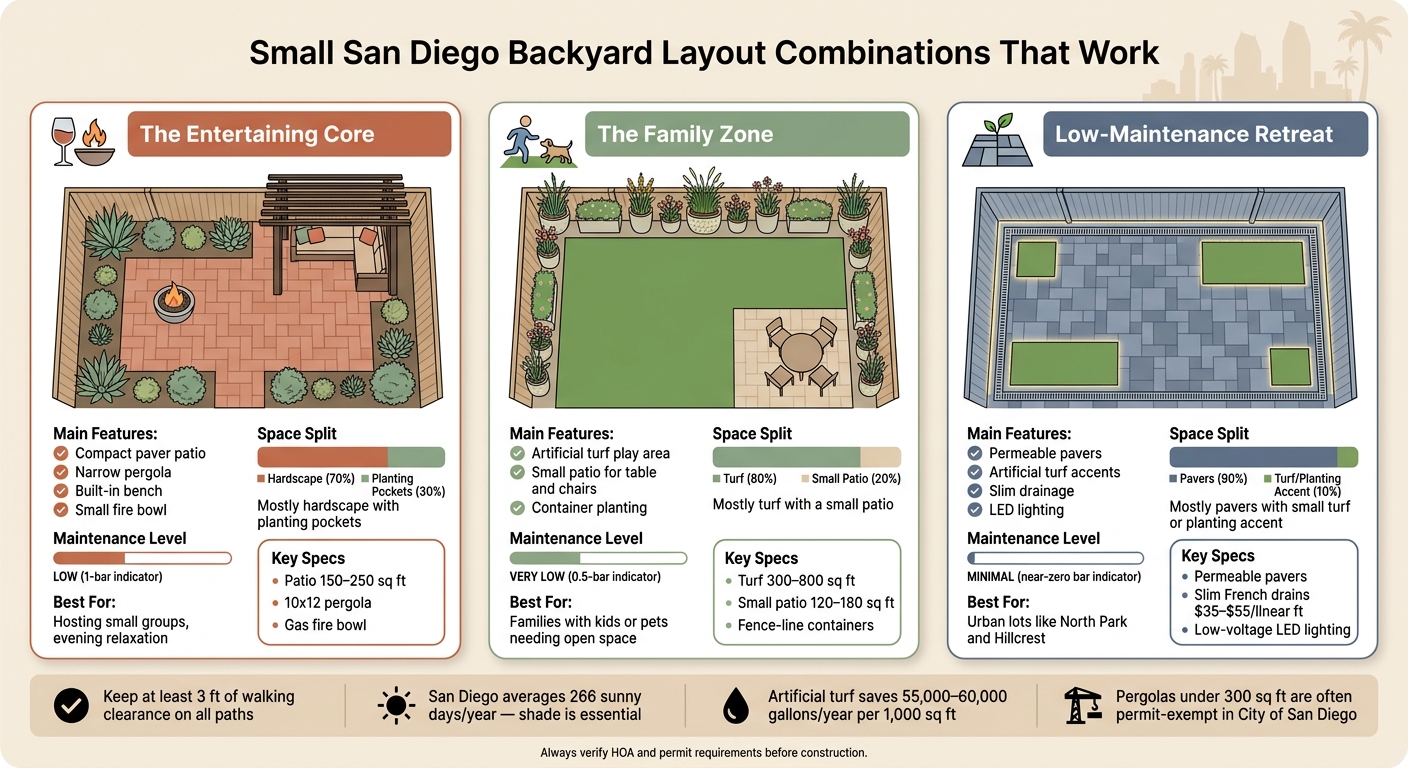
Small San Diego Backyard Layout Comparison: Which Design Fits Your Goals?
Once you’ve picked the main pieces, the last step is putting them together in a way that fits the yard without making it feel cramped.
The layouts below each put one main use first: entertaining, family play, or easy upkeep. That’s on purpose. In a small yard, the best setups usually have one lead feature, while everything else plays a support role.
| Layout | Main Features | Space Split | Maintenance | Best For |
|---|---|---|---|---|
| The Entertaining Core | Compact paver patio, narrow pergola, built-in bench, small fire bowl | Mostly hardscape, with planting pockets | Low | Hosting small groups, evening relaxation |
| The Family Zone | Artificial turf play area, small patio for a table and chairs, container planting | Mostly turf, with a small patio | Very Low | Families with kids or pets needing open space |
| Low-Maintenance Retreat | Permeable pavers, artificial turf accents, slim drainage, LED lighting | Mostly pavers, with a small turf or planting accent | Minimal | Urban lots like North Park and Hillcrest |
The Entertaining Core is a good fit if your main goal is having a clear place to gather. A narrow pergola, compact paver patio, built-in bench, and small fire bowl can give you a tight setup that still feels comfortable and usable.
The Family Zone gives more of the yard to turf, which makes sense for kids or pets that need open room. A small patio and fence-line planting round it out without taking over the space.
The Low-Maintenance Retreat fits smaller urban lots where the goal is a clean, polished look. Permeable pavers, small turf accents, and low-voltage lighting help keep the yard neat and easy to care for.
Conclusion: How to Decide What Fits Best
A small-yard remodel usually works best when you start with one clear priority and add only the features that support it. Coastal and inland lots call for different shade, drainage, and plant picks, but the same layout thinking still holds.
It's a pattern the design team at United Turf & Pavers runs into on almost every small San Diego lot: the projects that feel cramped are usually the ones trying to fit a fire feature, a full kitchen, and a play area into the same 400 square feet with equal weight given to each. In a small San Diego backyard, the best mix is usually the one that gives one feature the lead and lets the rest back it up.
FAQs
How do I choose the best layout for my small backyard?
Focus on a layout that creates clear zones, like a raised deck for dining and a lower patio for lounging. Instead of making every feature smaller, push hardscaping closer to the property edges so the yard feels bigger.
Built-ins help cut clutter fast. Think bench seating with storage, integrated planters, and fire tables that do more than one job. Vertical features like living walls, trellises, and overhead bistro lighting add depth without eating up floor space.
Do I need a permit for a pergola or fire feature in San Diego?
It depends on the installation.
Pergolas under 300 square feet are usually permit-exempt. But there are a few common exceptions. You may still need a permit if the pergola is in a Coastal Zone, extends into setbacks, or goes over 12 feet in height.
If the pergola includes electrical items like lights or fans, you’ll also need a separate electrical permit.
For fire features, a portable propane fire pit usually doesn't need a permit. But built-in natural gas features need a plumbing permit. And masonry or wood-burning fireplaces often need a full building permit.
What matters more in a small yard: patio space or turf?
In a small San Diego yard, neither one wins by default. It comes down to how you use the space.
Patios and pavers give you a steady surface for dining, lounging, and outdoor cooking. Artificial turf brings in greenery, a softer feel underfoot, and a low-maintenance spot for kids or pets to play.
In a lot of small yards, the best move is to use both. That mix helps define each area and makes the layout feel more intentional.