.webp)
.webp)

Choosing a Paver Pattern for Your San Diego Patio
August 10, 2026
The short answer: if you want the lowest install cost, running bond is often the best fit; if you need the strongest lock, herringbone usually wins.
Your pattern choice affects more than looks. It can change how open your patio feels, how well it handles foot traffic, and how much you may pay at $20–$35 per sq. ft. in San Diego. Soil also matters: coastal sandy lots often need less prep, while inland clay sites may need deeper digging, a thicker base, and tighter drainage control.
Before choosing, focus on these points:
- Running bond: simple layout, lower waste, good for small to mid-size patios
- Herringbone: strongest interlock, better for heavy foot traffic and furniture movement
- Basketweave: more decorative look, better for small seating areas or accents
- Modular: mixed-size layout, best on mid-size to large patios with a modern look
- Cost factors: labor, cuts, waste, slope, drainage, and soil conditions
- Site prep: coastal patios may need 6–8 inches of excavation; inland clay often needs more
- Drainage: patios should slope at least 1% away from the home; nearby grade should slope 5% for the first 10 feet
Top 5 Paver Patterns | The Strongest Pattern is...
sbb-itb-2b3b7d5
Quick Comparison
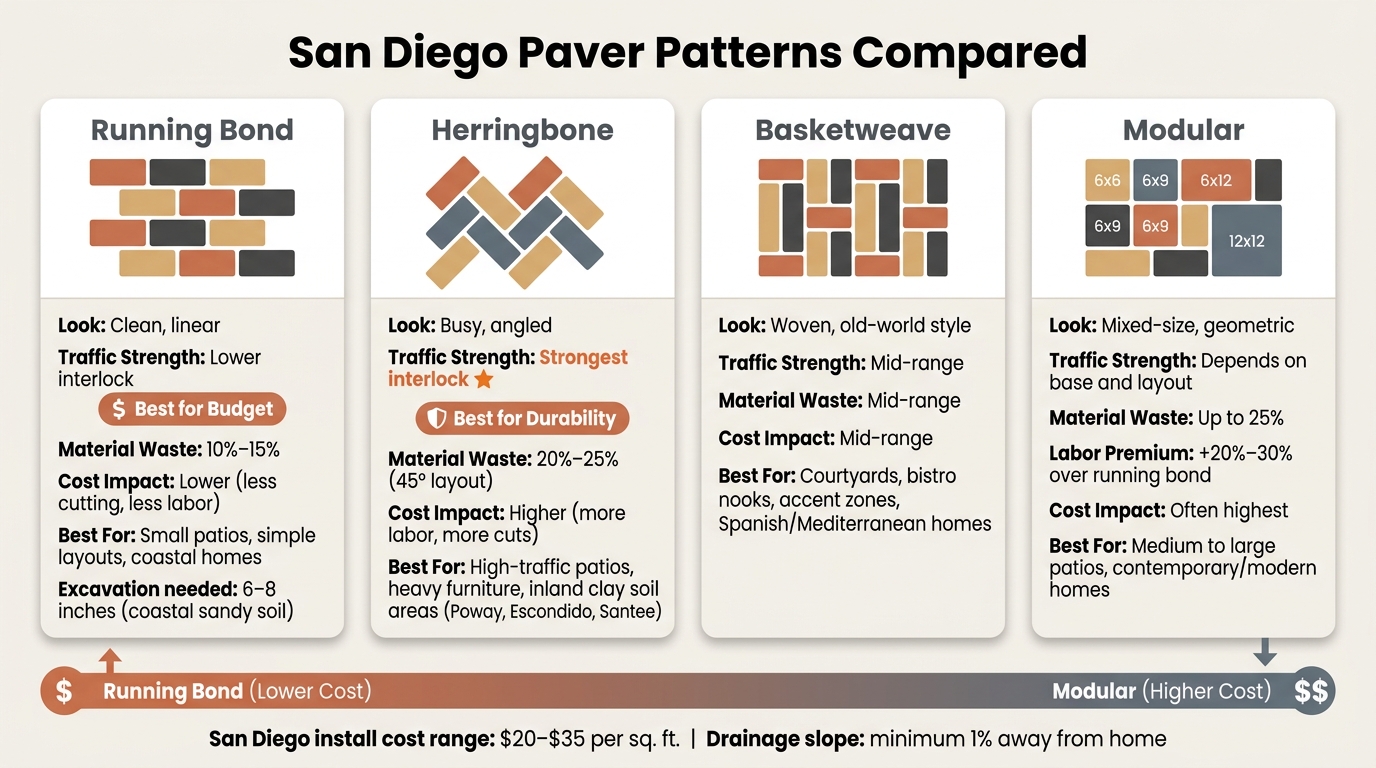
San Diego Paver Patterns Compared: Cost, Strength & Best Use
| Pattern | Look | Traffic Strength | Cost Impact | Best Use |
|---|---|---|---|---|
| Running Bond | Clean, linear | Lower interlock | Lower due to less cutting and about 10%–15% waste | Small patios, simple layouts |
| Herringbone | Busy, angled | Strongest interlock | Higher due to more labor and about 20%–25% waste on 45° layouts | High-traffic patios and paths |
| Basketweave | Woven, old-style | Mid-range | Mid-range labor | Courtyards, bistro spots, accent zones |
| Modular | Mixed-size, geometric | Depends on base and layout | Often highest due to layout time and extra cuts | Larger patios, modern homes |
If your yard is small and budget matters most, running bond is usually the safe pick. If your patio gets heavy daily use, herringbone is often worth the added labor. The sections below explain where each pattern fits best in San Diego homes.
1. Running Bond
Running bond is one of the simplest paver patterns. The pavers go down in parallel rows, with each joint offset by half a paver length. The result is a clean, linear look that fits well with contemporary and minimalist spaces.
On smaller patios, the direction of the rows can change how the space feels. Set the rows parallel to the back of the house, and the patio may look wider. Turn them perpendicular, and it can seem longer.
Paver size also changes the final look. A 6x9-inch paver gives you a nice middle ground between installation speed and visual detail. A 12x12-inch paver creates a cleaner, more open appearance.
Running bond is also one of the most budget-friendly layouts. Because the pattern is simple, installers usually make fewer cuts and waste less material - about 10% to 15%, compared with 20% to 25% for diagonal or more complex patterns. Less cutting usually means lower labor costs too.
If you want a bit more detail, a soldier course border can frame the patio without making the layout much harder to install.
If the patio needs more strength for heavier use, herringbone is the next pattern worth comparing.
2. Herringbone
Herringbone gives you a busier look, but it pays off with a tighter lock and better performance in high-traffic areas. The 45-degree version can make a narrow patio feel wider. The 90-degree version works better in straight-edged spaces.
The big upside is the interlock. Each paver locks against two others, which helps the surface resist shifting under heavy foot traffic. In inland San Diego areas like Poway, Escondido, or Santee, that matters. Clay soil in these places tends to swell when it's wet and shrink when it dries out, so patios deal with more movement through the seasons. That extra lock can help the surface stay more stable as the base shifts.
Herringbone's interlock helps the surface resist shifting under heavy foot traffic and soil movement.
The downside is price. A 45-degree layout needs diagonal cuts along the borders, which adds labor time and creates more waste. You should plan for 20%–25% waste with a 45-degree layout. Add in the tighter layout work, and herringbone usually sits near the top end of local patio pricing.
For a narrow garden path or a tight courtyard, the 90-degree layout is usually the better call. It lines up neatly with straight edges and cuts down on the amount of cutting needed. On larger patios, the 45-degree layout tends to look better, especially when you frame it with a soldier course border to clean up the edges.
If you want a more decorative layout with less structural lock, basketweave is the next pattern to compare.
3. Basketweave
Basketweave is a woven layout made from pairs of rectangular pavers set at 90-degree angles to each other. It has a hand-laid, old-world feel that gives the surface extra personality. It’s a good fit when looks matter more than handling constant foot traffic. In other words, this pattern works best when the patio is meant to stand out as a design feature, not just serve as a path.
In San Diego’s sun, the alternating paver pairs cast small shadows that give the surface more depth and texture. That’s why basketweave works well in entry courtyards, bistro nooks, and framed lounge areas. Since it leans more decorative than structural, it usually makes more sense in seating zones and courtyard spaces than on main walkways.
On a large, open patio, basketweave can start to feel busy. The same detail that adds charm in a smaller space can feel like too much when stretched across a broad surface. If your patio is on the larger side, it often works better as a featured inset or as a way to mark off one area, like beneath an outdoor dining table or next to a fountain.
Compared with running bond, the difference is pretty simple: running bond feels cleaner and more current, while basketweave feels more decorative. Basketweave also pairs well with Mediterranean and Spanish-style homes that are common in San Diego. Standard 4x8-inch brick-look pavers tend to give the best result if you want that classic look. Installation is moderately complex and calls for careful placement, which puts it right in the middle between basic layouts and patterns that take more time and labor.
For homeowners who want more layout flexibility and a cleaner geometric look, modular patterns are next.
4. Modular Pattern
If you want a patio layout that feels cleaner and a bit more custom, modular is a solid step up. This pattern uses three or more paver sizes in a repeating unit, which gives the surface a geometric look without long, straight lines running across the whole space. Instead of one paver size set in simple rows, you get a mix of squares and rectangles - like 6×6, 6×9, and 12×12-inch pieces - that adds rhythm without making the layout feel random.
Modular works best on larger patios, where plain rows can start to feel a little flat or too stiff. The mixed-size layout also gives installers more room to work at turf or gravel transitions.
The tradeoff is planning. This is usually the most labor-heavy pattern to install. Modular layouts often add 20% to 30% more labor than simpler options like running bond. On more complex jobs, waste can climb as high as 25% because of extra cuts along edges and corners. To keep everything lined up, installers rely on string lines and laser levels.
Cost tends to go up for the same reason: more labor, more cutting, and more time on layout. If you use large-format slabs, the price can climb even more. It also makes sense to budget for polymeric joint sand, which helps limit joint erosion and weed growth.
In inland areas like Poway or Escondido, site prep matters a lot. Clay soil and wet-dry cycles can shift modular units if the base isn't compacted well and the patio doesn't have a 2% drainage grade. So while modular can look sharper and more tailored, the right fit still comes down to patio size, foot traffic, and the style you want.
Which Pattern Works Best for San Diego Homes
The best paver pattern comes down to four things: patio size, foot traffic, soil, and the style of the house. In San Diego yards, each pattern has a clear lane.
Running bond is usually the best match for small coastal patios, especially in places like La Jolla bungalows or Del Mar beach cottages. Sandy coastal soil tends to drain well, so it often needs only 6–8 inches of excavation. The straight layout also works well in tighter spaces because it helps the patio feel open instead of crowded.
Herringbone is the go-to pick for patios that take more abuse. If you expect heavy foot traffic, outdoor dining setups, or lots of furniture movement, it holds up best. The downside is cost. It takes more labor to lay out, and the waste factor is higher too, usually around 15% to 25%.
Basketweave works best as an accent pattern in smaller areas. It pairs nicely with Spanish and more classic homes, but on a big patio, it can start to feel a bit busy.
Modular is a better fit for larger patios, especially around contemporary and modern homes. It has a clean geometric look, but the layout needs careful planning. If the spacing is off, the whole pattern can feel slightly out of sync.
The table below gives a quick side-by-side view.
| Pattern | Strengths | Limitations | Ideal Patio Size | Best-Fit Home Style |
|---|---|---|---|---|
| Running Bond | Simple to install; low waste; easy to expand later | Weaker interlock; can look unfinished if cuts aren't planned well | Small to medium | Coastal, Contemporary |
| Herringbone | Strongest interlock; handles heavy traffic and furniture | More labor-intensive; higher waste factor | Any size / high-traffic | Ranch, Traditional, Spanish |
| Basketweave | Decorative; adds vintage character to small areas | Can feel busy on large surfaces | Small / accents | Spanish, Traditional |
| Modular | Clean, geometric look; suits modern outdoor rooms | Requires disciplined layout and more careful planning | Medium to large | Contemporary, Modern |
Drainage can also swing the decision, especially on inland lots. A patio should slope away from the foundation at a minimum of 1% - about 1/8 inch of drop per foot - and California code also requires the ground next to the foundation to slope away at 5% for the first 10 feet. If you have inland clay soil that stays wet for 48–72 hours after a storm, it makes sense to look at permeable pavers or French drains during base prep.
Conclusion
Each pattern does a different job. The best one comes down to how your patio will be used day to day. Running bond can help keep costs down, herringbone handles load better, basketweave brings more personality, and modular layouts give you order and room to mix sizes. Your choice should fit the patio's size, foot traffic, soil, drainage, and the style of your home. Simpler patterns usually mean less labor and less waste. More detailed layouts usually cost more.
If you're watching the budget, a running bond field with a soldier course border is a smart middle ground. It gives the patio a more finished look without the labor tied to a full complex pattern.
Looks matter, sure. But the base and drainage are what decide whether the patio stays in good shape over time. This is the part of paver installation that United Turf & Pavers walks every homeowner through before pattern selection even comes up — start there: drainage, soil, and traffic flow. When the base is built the right way, pavers can last 30 to 50+ years.
FAQs
Which paver pattern is easiest to maintain?
Running bond is usually the easiest paver pattern to take care of and fix. The layout is simple, which makes installation more straightforward. And if a paver gets damaged or starts to sink over time, it’s usually easier to remove and replace a single piece without disturbing the rest.
No matter which pattern you choose, upkeep is pretty light. In most cases, that means routine sweeping, an occasional rinse, and checking the joint sand. That sand may need to be topped off every few years.
Does paver pattern affect how large my patio looks?
Yes. Your paver pattern can change how large your patio feels.
Large-format pavers and long, continuous patterns tend to give the space a cleaner, more open look. That can make a patio seem bigger than it is.
More detailed patterns, like circular or sunburst layouts, usually need extra room to show up well. On a small patio, they can feel crowded fast. In tighter spaces, simple framing and fewer pattern shifts usually work better.
How do I choose a pattern for clay soil?
With clay soil, stability comes first.
Clay swells when it gets wet and shrinks when it dries out. That constant movement can lead to shifting or settling over time. Because of that, Herringbone is often the go-to pattern. Its interlocking layout helps the pavers stay in line even when the ground moves a bit.
That said, the pattern isn't the main thing. Base prep matters more than anything else. For clay soil, use an 8- to 12-inch aggregate base. It also helps to place geotextile fabric between the virgin soil and the base so the layers stay separated and the foundation holds up better.