.webp)
.webp)

How Permeable Pavers Solve Drainage Issues
September 2, 2026
Permeable pavers help fix backyard drainage by moving rainwater below the surface instead of letting it pool, run downhill, or collect near your home.
If your yard has standing water, muddy side yards, slope washout, or runoff near the foundation, this system can help by:
- letting water pass through open joints
- storing water in a stone base
- draining it into the soil below
- routing extra water out with an underdrain when clay soil drains too slowly
In many inland San Diego yards, clay soil can hold water for 48–72 hours after rain. And storms can drop 2–3 inches in 24 hours. That combination is why patios puddle, soil erodes, and low spots stay wet. Permeable pavers address those problems best when paired with proper grading, especially the 5% slope away from the foundation for 10 feet noted in code.
Here’s the short answer: if your yard sheds water in the wrong direction or holds it too long, permeable pavers can reduce pooling, slow runoff, and help protect turf, hardscape, and the house.
What this article covers:
- where drainage problems show up in San Diego backyards
- how permeable pavers move water through the surface
- why clean aggregate and a deep stone base matter
- which problems this system fixes best
- where it fits in a full backyard remodel
- what maintenance keeps the joints draining well
This gives you a simple way to judge whether permeable pavers fit your backyard remodeling plans before any remodel work starts.
Learn about why Permeable Pavers are the Best for drainage
sbb-itb-2b3b7d5
Drainage Problems Permeable Pavers Can Fix
Drainage problems tend to show up after the first storm. A puddle sits on the patio. A muddy channel cuts through the side yard. Water starts moving toward the back of the house. Those are some of the most common failures permeable pavers deal with.
Water Pooling on Patios, Walkways, and Around Turf
When hardscape or turf bases don't drain well, water stays on the surface. Standard hardscape pushes water away instead of letting it soak in, so it travels to the lowest spot. That might be a patio corner, the edge of a walkway, or a turf seam where the base wasn't prepared the right way.
Soil Erosion, Slope Washout, and Runoff Toward the House
On sloped lots and in side yards, the issue often changes from standing water to moving water. If rain falls faster than the soil can take it in, runoff starts carrying soil with it. That leads to visible gullies, topsoil washing onto walkways, and dirt ending up in the street.
Narrow side yards are hit hard by this. They often work like channels, concentrating runoff and sending it straight toward the house or even onto a neighboring property. California Building Code requires ground next to a foundation to slope away at a minimum 5% grade for at least 10 feet. Even with that slope, fast-moving runoff can still overload a yard when the soil can't absorb water fast enough.
Compacted or Clay-Heavy Soil That Drains Slowly
Clay-heavy or compacted soil drains slowly, plain and simple. Water lingers near the surface longer, which leaves the ground soggy and slow to dry. In some yards, certain spots never seem to dry out between irrigation cycles.
Permeable pavers help by replacing surface runoff with controlled drainage below the surface. The next step is seeing how that system moves water under the ground.
How Permeable Pavers Move Water Below the Surface
Permeable pavers move water below the surface through a layered stone system.
Open Joints, Clean Aggregate, and a Stone Base Reservoir
Standard pavers usually fit tightly together. Permeable pavers work differently. They have engineered gaps between each unit, and those joints are filled with small, clean aggregate stone instead of sand. That lets water pass through the surface instead of sitting on top.
Under the pavers, a loosely packed crushed stone base gives water a place to go. A 4-inch aggregate base over an 8-inch subbase provides both storage and support below the pavers. The spaces between the stones work like an underground reservoir, so water moves into those voids and drains over time.
In San Diego's clay-heavy yards, that storage is a big deal because water moves slowly through native soil. Clay-heavy inland yards usually need more stone storage than sandy coastal yards.
How the System Reduces Pooling and Slows Runoff
After water enters the joints, it moves down through the aggregate layers and eventually reaches the native soil below, where it infiltrates slowly. In clay soils, an underdrain carries extra water away when the ground can't absorb it fast enough.
That below-surface flow helps prevent puddles, slow runoff, and cut down on erosion.
How Permeable Pavers Address Specific Drainage Problems
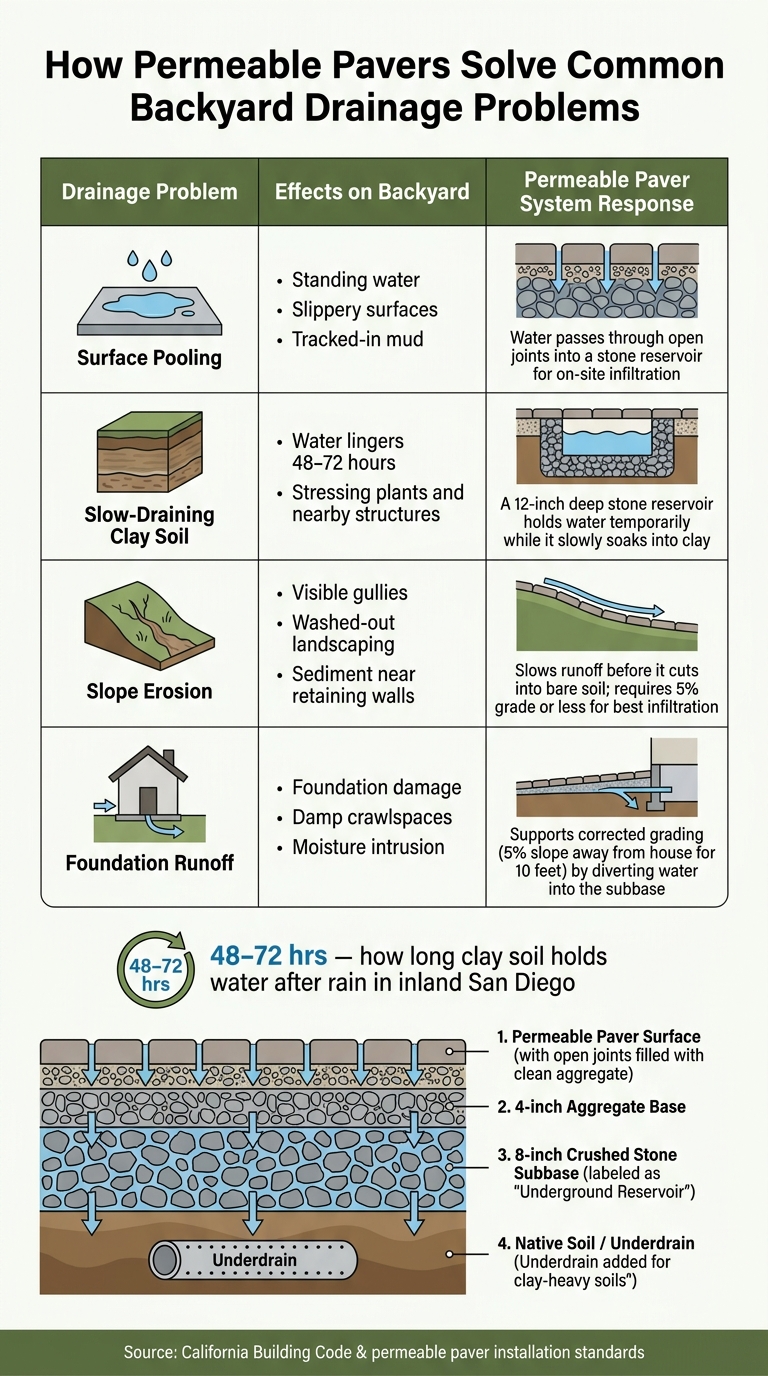
Permeable Pavers vs. Standard Pavers: Drainage Problem Solver
Below-surface drainage helps fix three common backyard headaches: pooling, erosion, and runoff near the house. And you can usually see the difference right in the yard.
| Drainage Problem | Effects on Backyard | Permeable Paver System Response |
|---|---|---|
| Surface Pooling | Standing water, slippery surfaces, tracked-in mud | Water passes through open joints into a stone reservoir for on-site infiltration |
| Slow-Draining Clay Soil | Water lingers 48–72 hours, stressing plants and nearby structures | A 12-inch deep stone reservoir holds water temporarily while it slowly soaks into clay |
| Slope Erosion | Visible gullies, washed-out landscaping, sediment near retaining walls | Slows runoff before it cuts into bare soil |
| Foundation Runoff | Foundation damage, damp crawlspaces, moisture intrusion | Supports corrected grading (5% slope) by diverting water into the subbase |
Each problem calls for a slightly different response, but the starting point stays the same: get water below the surface instead of letting it sit or rush across the yard.
Stopping Puddles on Patios and Walkways
On a standard hard surface, water tends to collect at low spots along patios, walkways, and turf edges. That’s where permeable pavers change the pattern. Water moves through the joints and down into the base layer instead of sitting on top.
That matters for day-to-day use. Wet pavers can get slippery, and standing water by a back door usually means mud gets tracked indoors. Because the surface dries faster, the area can get back into use sooner.
Reducing Erosion on Slopes, Grade Changes, and Side Yards
Permeable paver paths and landings interrupt runoff. They pull water into the subbase before it picks up speed and starts carrying off topsoil.
This works especially well in side yards, where runoff often follows a narrow grade change. A slim permeable walkway can help manage that flow without turning the space into a drainage problem. For the system to infiltrate well, the paver surface needs to sit at a 5% grade or less.
Protecting the House and Hardscape With Directed Drainage
California Building Code requires the ground within 10 feet of a foundation to slope away at a minimum 5% grade. Permeable pavers help by cutting down the amount of runoff that reaches the house to begin with.
When paired with corrected grading, downspouts, or catch basins, the system can deal with water from more than one source. In that setup, grading isn’t just a side detail. It’s part of how the whole drainage system works.
Where Permeable Pavers Fit in a Full Backyard Remodel
Permeable pavers work best when drainage is planned as part of the full remodel, not tacked on after the patio is done. That means layout and drainage should be handled in the same build, not as two separate jobs.
Coordinating Permeable Pavers With Grading, Turf, and Retaining Walls
During turf and paver excavation, it makes sense to fix slope and drainage at the same time. If permeable pavers sit near a retaining wall or below it, they should tie into the same drainage route, like a French drain, catch basin, or dry well. And in flat yards, excess water needs a clear place to go.
Along the edges of a yard, permeable pavers can catch runoff before it spills into turf or planting beds. But size matters here. The permeable section needs to match the amount of runoff it will take in.
Why Professional Installation Affects Long-Term Drainage Performance
After the layout is set, the base under the pavers does most of the heavy lifting. How well the system drains comes down to that base, and soil type plays a big part in what it should look like. In inland San Diego areas like Poway, Escondido, and Santee, clay soil often calls for 8–12 inches of excavation. In coastal spots like La Jolla or Del Mar, sandier soil usually needs 6–8 inches.
That’s why professional installation matters. Excavation depth, base thickness, and outlet placement all shape how the system performs over time.
United Turf & Pavers is a licensed San Diego contractor (CA #1138157) that handles drainage grading, permeable pavers, turf, and retaining walls in full backyard remodels.
Maintenance and Long-Term Performance
Once the system is installed, a little upkeep goes a long way in keeping drainage on track. Permeable pavers need light maintenance so the joints stay open and water can keep moving through them. Regular sweeping or blowing helps stop leaves and debris from breaking down and packing into the joint openings.
If basic cleaning doesn’t do the job, professional vacuum sweeping can pull out sediment that has settled deeper between the pavers. After vacuum sweeping or power washing, check the joint aggregate and top it off as needed so the joints stay open for drainage.
It also makes sense to watch how the surface performs during rain and irrigation cycles. After a heavy rain, look for puddles that stick around for more than 24 hours. That’s a clear sign the joints may be clogging or the slope may need attention. It’s also smart to inspect the surface after sprinkler changes. If some areas stay wet, water may be collecting where it shouldn’t, which gives you a chance to fix the issue before the rainy season starts. These simple checks help keep the system working as intended, much like the upkeep for a multi-surface backyard with pavers and turf.
Conclusion: Why Permeable Pavers Work as a Drainage Fix
If pooling, erosion, and runoff are the issue, permeable pavers tackle all three by sending water below the surface. In San Diego backyards, clay soil and poor grading often slow drainage. This system lets water pass through the joints and into a stone base, where it sits for a short time instead of pooling on top or racing across the yard.
That said, the setup needs to fit your yard. Soil type and slope matter. When permeable pavers are paired with corrected grading, they do a much better job of moving water away from the house.
Long-term results come down to proper installation and simple upkeep. If the joints clog, drainage slows down. That's why routine cleaning helps keep the system working year after year.
Permeable pavers are one of the more common fixes United Turf & Pavers recommends when a backyard remodeling project turns up standing water, erosion, or runoff near the house.
FAQs
Are permeable pavers right for clay soil?
Yes - permeable pavers can work well on clay soil if the install is done right.
Clay drains slowly and tends to hold water, so you can’t treat it like a standard paver job. These systems rely on engineered joints, an open-graded crushed stone base, deeper excavation - often 8–12 inches - about 12 inches of combined aggregate, and proper grading of 5% slope or less.
Do permeable pavers need an underdrain?
Not always. Permeable pavers still need a properly engineered base. In most cases, that means a thick layer of open-graded crushed stone that supports the pavers and holds water for a short time.
If the site needs more drainage capacity, you can add drain channels. And if you're dealing with dense clay soil, deeper excavation gives water more room to move through the base and soak into the ground around it.
How much maintenance do permeable pavers need?
Permeable pavers need regular upkeep if you want them to keep draining well over time. Day-to-day care is pretty simple: blow or sweep the surface so the joints stay clear of leaves, dirt, and other debris.
Some jobs, though, are better left to a pro. Professional vacuum sweeping usually costs $2.50 to $4.50 per square foot. Power washing is another service you may need from time to time, and that usually runs $125 to $500, depending on the size of the area. After cleaning, the joint aggregate may also need to be topped off.