


Why Landscape Lights Fail in San Diego’s Rainy Season
November 4, 2026
Rain-related landscape lighting failures often point to wet connections, corrosion, or damaged cable, but check power and controls before assuming you need new wiring. Start with dry, accessible controls: reset a dry, undamaged GFCI once, then stop if it trips again. Check your timer, too: Daylight Saving Time ended on November 1, 2026.
Your next step depends on the failure pattern and your yard’s conditions:
- One dark zone, flickering, or dim lights: Record which fixtures fail and whether the problem follows rain. Don’t dig or open the transformer.
- Coastal or inland exposure: Look from a dry spot for salt corrosion, pooling water, irrigation spray, or disturbed soil.
- LED upgrade or rewire: LEDs suit a sound system. Recurring moisture or cable faults need professional assessment. Read DIY vs. professional landscape lighting before attempting a repair yourself. New bulbs won’t fix leaking connections.
Leave equipment with visible water intrusion switched off until inspected. If rewiring is needed, coordinate cable routes with drainage and backyard work, and price the full scope of landscape lighting installation.
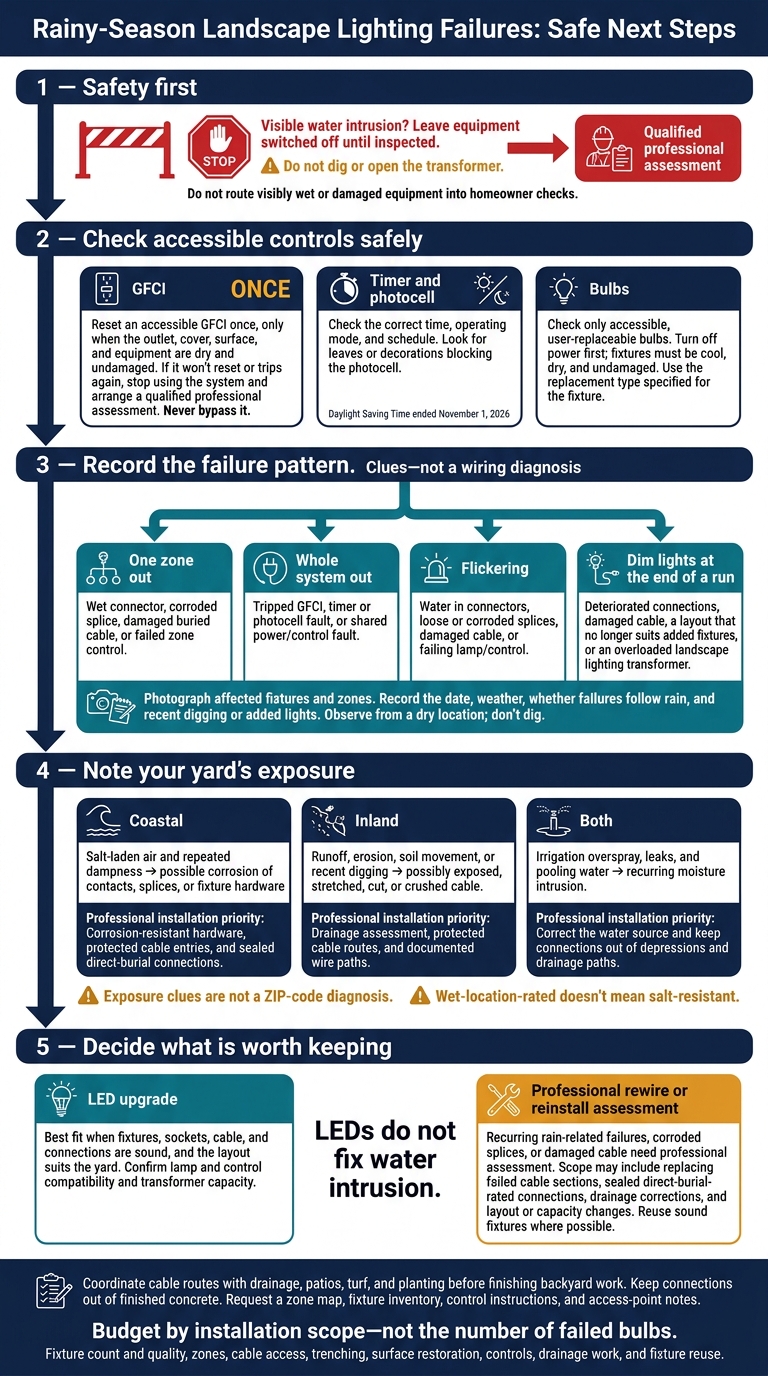
Rainy-Season Landscape Lighting Failures: Safe Next Steps
Troubleshoot Outdoor Landscape Lights Not Working
sbb-itb-2b3b7d5
Match Lighting Problems to Possible Causes
Rain can expose a weak point in your lighting system. The failure pattern after that first rain often shows where to look. Focus on the pattern, not just one fixture. Use these clues to narrow down possible causes - not to troubleshoot wiring.
| Symptom | Possible causes | Safe homeowner checks | Potential system solution |
|---|---|---|---|
| One zone out | Wet connector, corroded splice, damaged buried cable, or failed zone control | Photograph the dark section. Note recent planting, edging, irrigation work, or disturbed soil. Check whether other zones work, but don’t dig. | If failures recur, replace the affected cable run and install sealed connections. |
| Whole system out | Tripped GFCI, timer or photocell fault, or shared power/control fault | Follow the GFCI check below. Review timer settings and check for photocell blockage. | Have a qualified professional assess the system, then replace faulty controls or correct moisture and cable faults. |
| Flickering | Water in connectors, loose or corroded splices, damaged cable, or failing lamp/control | Record whether one fixture, one branch, or everything flickers - and whether it happens after rain. | Reseal connections, replace cable or fixtures, or reinstall more of the system if faults affect many areas. |
| Dim lights at the end of a run | Deteriorated connections, damaged cable, a layout that no longer suits added fixtures, or an overloaded landscape lighting transformer | Compare nearby and distant fixtures from a dry location. Note when more lights were installed. | Review transformer sizing and layout before adding more fixtures. |
See the lighting cost and installation guide for planning details.
Corrosion increases resistance, which can dim lights farther along a cable. Added fixtures also increase demand. Repeated rain-related failures across several branches usually point to the need for rewiring with sealed outdoor connections. If the checks above leave the pattern unchanged, the problem is usually in the system rather than a single bulb.
Safe Checks for the GFCI, Timer, Photocell, and Bulbs
GFCI: Reset an accessible GFCI once, and only when the outlet, cover, surface, and equipment are dry and undamaged. If it won’t reset or trips again, stop using the system and arrange an assessment by a qualified professional. Never bypass it.
Timer and photocell: Check accessible external controls for the correct time, operating mode, and schedule. Daylight Saving Time ended on November 1, 2026, so some timers need manual adjustment. Review your schedule for shorter fall and winter evenings, and look for leaves or decorations blocking the photocell.
Bulbs: Check only accessible, user-replaceable bulbs. First, turn off the power and make sure fixtures are cool, dry, and undamaged. Use the replacement type specified for the fixture.
Photograph where your low voltage landscape lighting isn’t working. Record the date, weather, affected zones, and whether the problem follows rain. From a dry location, look for water trapped behind lenses, cracked seals, corrosion, or exposed conductors. Leave equipment with visible water intrusion switched off until it has been inspected.
When recording repeat failures after dry-weather reset checks, note their location as well as the symptoms. That detail can help a qualified professional distinguish a system fault from a schedule issue.
Coastal vs. Inland Lighting Failure Patterns
Coastal conditions add salt exposure. Inland, drainage problems and shifting soil can stress cable routes. Salt deposits can form a moisture-holding film on exposed metal and connection points, speeding corrosion as surfaces repeatedly get wet and dry. These patterns aren’t a ZIP-code diagnosis. After checking the GFCI, timer, and bulbs, use them to narrow down the next likely failure point.
| Setting | Exposure or site conditions | Possible failure pattern | Installation priority |
|---|---|---|---|
| Coastal | Salt-laden air and repeated dampness | Corroded contacts, splices, or fixture hardware; intermittent flickering or one fixture/zone failing | Corrosion-resistant hardware, protected cable entries, and sealed direct-burial connections |
| Inland | Runoff, erosion, soil movement, or recent digging | Exposed, stretched, cut, or crushed cable | Drainage assessment, protected cable routes, and documentation of wire paths before future landscaping work |
| Both | Irrigation overspray, leaks, and pooling water | Recurring moisture intrusion around fixtures and connections | Correct the water source and keep connection points out of depressions and drainage paths |
Wet-location-rated doesn’t mean salt-resistant. In coastal yards, check material and finish specs separately from the wet-location rating. Inland, keep cable routes away from runoff channels and areas likely to be dug up later.
After rain, check from a safe, dry spot for water pooling in low areas. Also note whether sprinkler spray hits fixtures. Drainage depends on slope, soil compaction, irrigation, and past landscape work - not just location.
Use the coastal vs. inland landscape lighting guide to compare your yard’s actual exposure, drainage, and cable routes before planning a reinstallation.
If the same wet spots cause failures after each rain, another patch may not be the best fix. The next step is often an LED upgrade or a rewire with sealed connections.
When to Upgrade to LEDs or Rewire
If the same lights fail after every storm, stop patching and assess what’s worth keeping. An LED upgrade makes sense only if the existing system is sound. If cable or connections keep failing, choose a rewire. LEDs do not fix water intrusion.
Let the failure pattern guide whether you keep the current system or start over with sealed connections.
| Decision factor | LED upgrade | Rewire or reinstall |
|---|---|---|
| Best fit | Fixtures, sockets, cable, and connections are sound, and the layout suits the yard | Lights repeatedly fail after rain, splices are corroded, or buried cable is damaged |
| Fixture reuse | Keep fixtures with sound housings, seals, sockets, and compatible lamps | Reuse sound fixtures where possible; replace those with recurring moisture damage |
| Connections and drainage | Existing connections must be dry and secure | Replace failed cable sections and use sealed, direct-burial-rated connections |
| Compatibility and capacity | Confirm LEDs work with existing equipment and controls; check transformer capacity | Check control compatibility during the redesign and plan capacity for intended additions |
| Maintenance | Less disruption when the existing system is worth keeping | Document cable routes and map access points for future service |
Before pricing the project, separate reusable fixtures from failed cable, splices, and controls. Use this guide to landscape lighting transformer sizing and installation costs to help set your budget. Costs depend on fixture count and quality, zones, cable access, trenching, surface restoration, controls, drainage work, and fixture reuse - not the number of failed bulbs.
Plan Lighting Reinstallation With Backyard Remodeling
If you need a rewire, plan it before finishing hardscape and planting. During backyard remodeling, coordinate cable routes and excavation with patios, turf, planting beds, and drainage. Keep connections out of finished concrete.
Focus on reliable scheduling, accessible connections, and less maintenance. At handoff, request a zone map, fixture inventory, control instructions, and access-point notes.
United Turf & Pavers provides lighting upgrades and reinstalls, rather than standalone repairs. Define the scope to determine whether an LED conversion can reuse the current system or needs new cable routes and sealed connections.
Conclusion: Address Repeat Failures Before the Next Rain
Once you’ve matched the symptom pattern, recheck the controls from a dry, accessible spot: the GFCI, timer, photocell, and bulbs. Reset the GFCI once, and stop if it trips again. Confirm the timer follows your schedule after Daylight Saving Time ended on November 1.
A dark zone points to a local fixture, connection, or cable fault. Flickering may mean moisture or corrosion, and dim lights at the end of a run can mean a bad connection farther along. If the system is otherwise sound, an LED upgrade may be enough. Repeated storm failures, corrosion, or cable damage call for sealed rewiring or full reinstallation, which lighting and electrical services can scope. Check transformer sizing before you reinstall.
Before the next storm, work through the rainy-season backyard protection checklist to protect the rest of the yard.
United Turf & Pavers plans cable routes for rewiring alongside drainage, pavers, and turf work as part of its backyard remodeling services.
FAQs
Are my landscape lights safe if they work again after drying?
Not necessarily. Landscape lights may start working again after moisture evaporates, but drying out doesn’t fix the leak. Water getting in usually means splices, connectors, or fixtures have lost their watertight seals. Each time it rains, moisture can enter again and continue corroding components.
Repeated wetting and drying can damage wiring and connections, causing short circuits, persistent flickering, or complete system failure.
How can I prevent lighting failures before the next storm?
Clean fixture lenses and trim any vegetation blocking the light. After heavy rain, check for wiring exposed by soil erosion and have it reburied.
For long-term reliability in coastal areas, use marine-grade materials such as 316 stainless steel or brass. Fully seal connections to keep moisture out. An annual professional inspection can check the transformer and confirm that timer settings account for shorter winter days.
Can I rewire just one failing lighting zone?
You can rewire a single zone if the damage is limited to its wiring or corroded splices. But frequent flickering, dimming, or zone failures may point to problems beyond that run, such as poor voltage distribution, outdated components, or moisture getting into multiple parts of the system.
A targeted rewire with sealed, waterproof connections and quality LED fixtures can last longer than repeated patches. If failures affect multiple areas, a full system upgrade may be more effective.