.webp)
.webp)

Louvered vs. Fixed-Roof Pergolas in San Diego
September 27, 2026
If you want control over sun, airflow, and light rain, a louvered pergola is the better pick. If you want steady cover with fewer parts, a fixed-roof pergola is the simpler choice.
In San Diego, that decision comes down to seven things: shade control, rain cover, airflow, moving parts, maintenance, cost, and yard rules. A louvered system opens and closes as conditions change, but it costs $16,000 to $55,000+ and needs power, drainage, and more upkeep. A fixed roof gives constant shade and rain cover, works well for fans and lighting, and has fewer parts to check over time.
Before choosing, look at:
- Sun exposure: How much sun hits your patio, especially on west-facing yards from 2:00 PM to 5:00 PM
- Rain drainage: How rain drains off the roof during San Diego's winter wet season, and whether that runoff ties into the yard's existing drainage and grading
- Airflow vs. cover: Whether you want airflow or full-time cover
- Power needs: Whether your project needs lighting and electrical work for louvers, lights, fans, or heaters
- Permits and setbacks: Rules that can change by city, county area, Coastal Zone, or HOA
- Roof height: Clearance for grills, since outdoor cooking areas may need 9 to 11 feet of vertical clearance
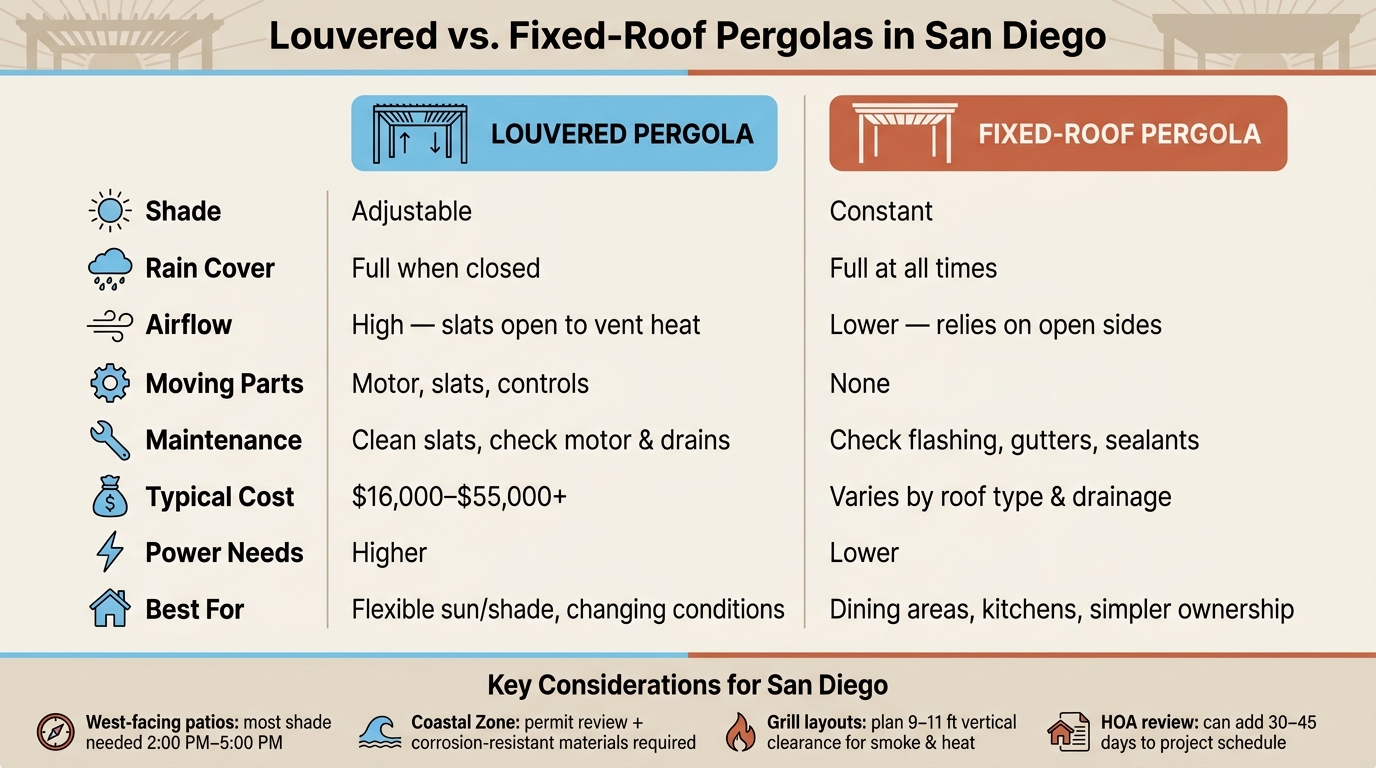
Louvered vs. Fixed-Roof Pergolas: San Diego Comparison Guide
Patio Cover VS. Louvered Pergola (and Motorized Smart Systems) | Azenco Outdoor
sbb-itb-2b3b7d5
Quick Comparison
| Factor | Louvered Pergola | Fixed-Roof Pergola |
|---|---|---|
| Shade | Adjustable | Constant |
| Rain cover | Full when closed | Full at all times |
| Airflow | Higher | Lower |
| Parts | Motor, slats, controls | No moving roof parts |
| Upkeep | Clean slats, check motor and drains | Check flashing, gutters, sealants |
| Typical cost | $16,000–$55,000+ | Varies by roof type, structure, and drainage |
| Best fit | Patios with changing sun and heat | Dining areas, seating zones, outdoor kitchens |
| Power needs | Usually higher | Usually lower |
The short answer: if your yard gets shifting sun and you want on-demand control, a louvered pergola fits better; if your goal is simple, steady protection, a fixed roof is often the better match. The full comparison below breaks down where each option works best in San Diego.
How Each Pergola Roof Works
Louvered Pergolas: Adjustable Shade, Airflow, and Rain Control
A louvered pergola uses motorized aluminum slats that can open, tilt, or close with a remote, wall switch, or app. When the slats are open, you get sun and airflow. When they close, they can direct rain away if the system has the right slope, seals, flashing, and drainage.
That last part matters. Rain control isn't just about shutting the slats and calling it a day. The pitch, seals, flashing, gutters, and drainage path all need to work as one system. Most setups move water through channels inside the frame, then down through hollow support posts, and out at ground level or into a planned drainage area.
Ask your installer one plain question before work starts: Where does the water go? You want a clear answer before the project begins.
Fixed-Roof Pergolas: Fixed Coverage With No Moving Parts
A fixed-roof pergola stays in one position. Common materials include metal, insulated panels, and polycarbonate. Since nothing opens, tilts, or closes, the amount of shade is set by the roof's material and orientation. That means the coverage stays steady throughout the day.
Because the ceiling doesn't move, it gives you a stable surface for ceiling fans, light fixtures, patio heaters, and outdoor kitchen equipment. You can plan wiring and mounting hardware without worrying about moving parts getting in the way. Water drains through slope, flashing, gutters, and downspouts.
The tradeoff is simple: you get fixed shade, but less control over ventilation.
These differences set up the next comparison: shade, rain handling, airflow, maintenance, and convenience.
Louvered vs. Fixed-Roof Pergolas: Performance Comparison for San Diego
Now that the roof mechanics are clear, it helps to see how each option performs in an actual San Diego backyard. Strong sun, winter rain, and coastal air all play a part in how these systems feel day to day.
Comparison Table: Shade, Rain, Airflow, Maintenance, and Convenience
Here’s the practical breakdown.
| Feature | Louvered Pergola | Fixed-Roof Pergola |
|---|---|---|
| Shade Control | Adjustable shade | Constant, full coverage |
| Rain Protection | Full when closed | Permanent full coverage |
| Natural Ventilation | High - slats open to vent heat | Lower - relies on open sides |
| Moving Parts | Higher - motorized slats and electrical | None |
| Maintenance | Low - occasional motor and slat checks | Very low - no moving parts |
| Electrical Needs | High - motor plus integrated lighting | Moderate - optional lighting and fans |
| Outdoor Kitchen Compatibility | Excellent - adjustable venting | Good - requires adequate vertical clearance |
| Ease of Use | On-demand flexibility | Set-and-forget consistent shade |
Strengths and Tradeoffs at a Glance
A louvered pergola gives you more control as conditions shift through the day. You can open the slats on a cool morning, tilt them as the sun moves, and close them when rain rolls in. That kind of flexibility stands out in San Diego, where one yard can go from mild to hot in a few hours.
A fixed-roof pergola takes the opposite path. You get steady overhead coverage without motors or controls, which makes ownership simpler. The tradeoff is pretty clear: the shade level stays the same even when you’d rather let in more light or heat can’t escape as easily.
| Louvered Pergola | Fixed-Roof Pergola | |
|---|---|---|
| Works best for | Flexible sun/shade, rain control, changing conditions | Consistent shade, outdoor kitchens, simpler ownership |
| Main tradeoff | Higher cost and mechanical complexity | No ventilation control, fixed shade level |
The better fit comes down to how you use the space. Next, look at cost, maintenance, and installation conditions across San Diego County.
Cost, Maintenance, and San Diego Installation Conditions
Once roof performance is clear, the final call usually comes down to three things: price, upkeep, and site rules. And that’s where projects can start to look very different from one yard to the next.
The final price isn’t just about the pergola itself. It also depends on footings, drainage, electrical work, site access, and whether the pergola is part of a bigger patio, outdoor kitchen, or landscape job.
Louvered Pergola Pricing and Main Cost Drivers
A louvered pergola usually falls in the $16,000–$55,000+ range. On the low end, you’re usually looking at a small freestanding unit with easy site access. On the high end, a larger attached system with reinforced footings, motorized louvers, lighting, gutters, and electrical work can go past $55,000.
A few things push the number up fast:
- Overall size
- Whether it attaches to the house
- Footing depth
- Drainage needs
If the pergola is bundled into a larger remodel, mobilization and site-prep costs can drop. That can make the full project pencil out a bit better.
When you compare bids, don’t just look at the total. Ask for separate line items for the structure, footings, roof system, motors, electrical service, lighting, drainage, and any demolition or hardscape restoration. That makes it much easier to compare one proposal to another.
Maintenance Differences: Moving Parts vs. No Moving Parts
After price, upkeep is usually the next big split. A louvered system gives you more control, but that control comes with more parts to watch. A fixed roof is simpler.
With a louvered pergola, maintenance usually means cleaning the louvers and channels, checking motor operation, and keeping drainage paths clear. In coastal air, cleaning matters more, and hardware and wiring need closer corrosion checks.
A fixed roof has its own checklist too. Flashing, gutters, sealants, and downspouts still need attention. If a gutter clogs or flashing fails, you can end up with leaks, staining, or erosion damage just as easily as you would with a neglected drainage channel on a louvered system.
Permits, Setbacks, Drainage, and Site Prep in San Diego County
In San Diego, site rules can shape both the design and the timeline. Permits vary by jurisdiction, and that matters more than many homeowners expect. The City of San Diego and unincorporated San Diego County use separate permitting and zoning systems.
In the City of San Diego, patio covers up to 300 square feet may be permit-exempt for single-family and duplex homes. But that exemption can disappear in the Coastal Zone, near sensitive lands, inside setback conflicts, or within a historic district or planned development. And even if the structure itself is exempt, that does not remove the need for separate electrical, mechanical, or plumbing permits. Motorized louvers, lighting, fans, and heaters may still need their own permits.
In unincorporated San Diego County, patio covers are generally limited to a 12-foot maximum height and must keep at least a 5-foot minimum distance from the property line. Both jurisdictions also require a clear drainage path from the roof to the discharge point. Put that discharge point on the plan before work begins.
Which Pergola Fits Your Yard
After price, upkeep, and site rules, the last call comes down to one thing: how you plan to use the space.
Choose a Louvered Pergola for Flexible Sun, Shade, and Ventilation
A louvered pergola works well in yards where the sun shifts during the day. It also makes sense if you want to let heat escape on a warm afternoon, then close the roof when rain starts rolling in.
If you're adding a built-in grill, this option can be easier to map out from day one. That’s because the 9–11 feet of vertical clearance needed for heat and smoke dissipation can be planned along with the roof system instead of treated like an afterthought.
Choose a Fixed-Roof Pergola for Consistent Coverage and Simpler Ownership
A fixed roof is a better fit for dining areas or seating zones where steady shade and rain cover matter more than adjustability.
It’s also simpler to own. There are no moving parts to look after and no motors to service. If your patio needs dependable cover with low upkeep, this type is often the better match.
Four Factors to Guide Your Final Decision
These checks can help narrow the choice fast:
- West-facing patios need the most shade control, especially from 2:00 PM to 5:00 PM.
- Coastal Zone properties need permit review and corrosion-resistant materials.
- Grill layouts need roof height planned for smoke and heat clearance.
- HOA review can add 30–45 days to the schedule.
Conclusion: Match the Roof to How You'll Use the Space
A louvered pergola earns its price with control: sun, airflow, and rain response on demand. A fixed roof earns its keep by having nothing left to break.
Site conditions decide more of this than personal taste does. Coastal air pushes toward the fixed roof's simpler hardware. A west-facing patio pushes toward louvers. A grill under the structure pushes toward whichever option gives you 9 to 11 feet of clean vertical clearance.
This is the sequence the design team at United Turf & Pavers works through on every pergola project in San Diego: site conditions first, then drainage, then power. They map footings and a discharge point before either roof type gets bid, since drainage and grading work costs more to retrofit than to plan up front. Projects that pair the pergola with an outdoor kitchen or new lighting and electrical work tend to settle the roof type early, since both depend on where the structure ends up.
FAQs
Which pergola is better for west-facing patios?
For west-facing patios in San Diego, louvered pergolas are the better pick. They can close all the way during the hottest part of the afternoon to block direct sun, then open back up when things cool down.
A solid roof is often the go-to suggestion for harsh afternoon sun. But a louvered system gives you that same shade with more control.
Do louvered pergolas need electricity?
Yes - if they have motorized louvers or built-in lighting, they need electricity.
Once electrical parts are part of the setup, the project also needs a separate MEP permit along with any required structural permits. A motorized louvered roof, lighting, or fans will trigger that separate electrical permit.
Will I need a permit for a pergola in San Diego?
Usually, yes. In San Diego, pergolas under 300 square feet on single-family homes and duplexes may be exempt, but that does not apply in the Coastal Zone.
You’ll also need a permit if the project includes electrical work, like lights, fans, or a motorized louvered roof. The same goes if the pergola extends into required setbacks.
In most cases, your contractor should take care of city permits and any HOA approvals that come up.