.webp)
.webp)

Hydroseeding & San Diego Grading Permits: What's Required
September 16, 2026
Yes. Your grading permit can stay open even after dirt work is done if slope stabilization is still incomplete.
Final grading sign-off in San Diego County requires more than shaped slopes. You need finished drainage, erosion control that matches the approved plan, and, in many cases, established slope cover before inspection. Hydroseeding alone isn't enough if the slope is steep, bare, or not yet growing in.
Watch for these sign-off blockers:
- Rough grading and final approval are separate steps
- Erosion, gullies, or standing water can delay sign-off
- Hydroseed counts once the slope stabilizes and grows in
- Working irrigation may be required if your plan calls for it
- The county may still require physical measures like riprap, drains, blankets, or walls
- County permit notes and approved plans set what must be finished before closeout
Timing trips up most homeowners. Seed needs time to grow, and rain can damage bare soil before that happens. A slope can fail final review even if you applied hydroseed days or weeks earlier. Inspectors check finished grading and drainage work on the ground. The date on your hydroseed invoice doesn't factor in.
Quick Comparison
| Item | What it means for your permit closeout |
|---|---|
| Rough grading | Earthwork may be done, but permit may still stay open |
| Final grading | County checks drainage, slope condition, and permit compliance |
| Hydroseeding | May help with erosion control, but bare or patchy growth can still block sign-off |
| Planted cover | Often used for long-term slope cover when growth is established |
| Blankets / BMPs | May be needed to protect disturbed soil while vegetation fills in |
| Walls / riprap / drains | Often used where slopes are steep or runoff needs control |
| Irrigation | May be required before sign-off if shown on approved plans |
Before scheduling inspection, property owners should confirm that drainage flows to the right outlet, slopes show stable cover, and all permit-required items are in place. The full article below breaks down when stabilization is required, where hydroseeding fits, and what inspectors tend to check before final grading approval.
sbb-itb-2b3b7d5
When stabilization is required before final grading approval
The County can require stabilization before it gives final grading sign-off.
How grading permits create erosion-control obligations
When the County issues a grading permit, it also sets the conditions for final sign-off. One of those conditions is stopping erosion on disturbed soil and finished slopes.
This becomes most urgent before the wet season. Exposed slopes tend to fail faster when rain starts hitting bare ground.
Rough grading vs. final grading inspection
Rough grading covers earthwork and slope formation. Final grading focuses on drainage and stabilization.
That split matters. The County can delay final approval until the slope is stabilized. If inspectors see erosion channels, gullies, or standing water, final sign-off can be blocked.
Why timing matters on finished slopes
Start stabilization as soon as each slope is finished so the work can be reviewed before final sign-off. From there, the next step is figuring out which stabilization methods may satisfy the County.
What can satisfy the County's stabilization requirement
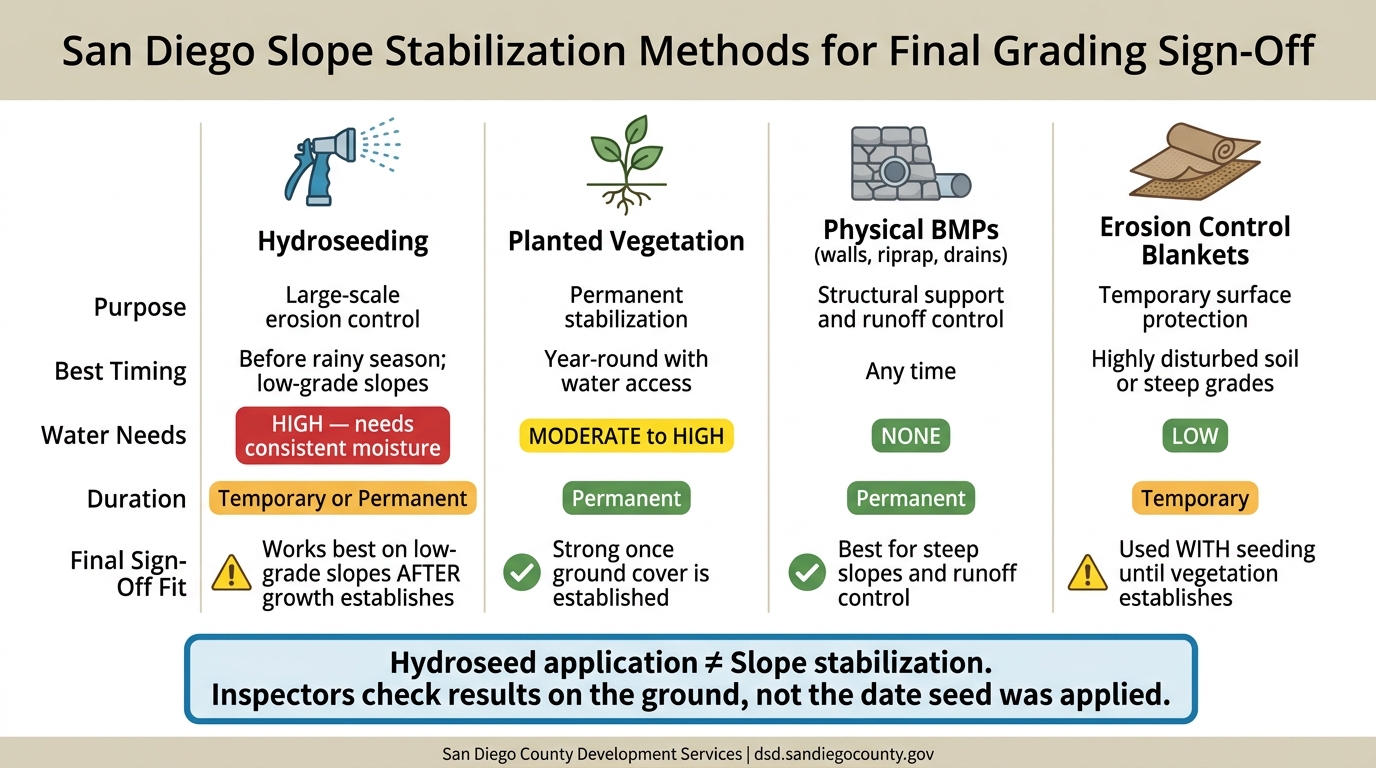
San Diego Grading Permit: Slope Stabilization Methods Compared
Once stabilization is required, the next step is figuring out what the County will accept for final sign-off. In most cases, the answer comes down to the site, the permit conditions, and the approved permit notes. Those notes usually set the rules.
Hydroseeding, vegetation, and physical BMPs
In simple terms, acceptable stabilization usually falls into two buckets: vegetation-based methods and physical BMPs.
Vegetation-based methods include hydroseeding and planted vegetation. Physical BMPs include rock riprap, retaining walls, and drainage features like channel drains and catch basins. Which one makes sense depends on the slope, the soil, and whether the County is looking for temporary or permanent stabilization. That’s why the approved permit notes matter so much. The method has to fit both the slope conditions and the timing of the final inspection.
When seed alone is not enough on slopes
This is where many sites run into trouble. On steeper slopes or heavily disturbed soil, hydroseeding on its own may not give enough immediate protection. Seed takes time to germinate and grow. Meanwhile, bare soil can wash out before that happens.
If the seed has not established by the time of inspection, the slope may not qualify for sign-off.
On those slopes, the County may expect added measures, such as erosion control blankets to hold seed in place, planted vegetation for longer-term cover, or physical BMPs like retaining walls.
Stabilization options for final approval: comparison table
The comparison below keeps the options clear at a glance.
| Method | Purpose | Timing | Water needs | Duration | Typical fit for final sign-off |
|---|---|---|---|---|---|
| Hydroseeding | Large-scale erosion control | Before rainy season; low-grade slopes | High - needs consistent moisture to establish | Either | Works best on low-grade slopes after growth establishes |
| Planted Vegetation | Permanent stabilization | Year-round with water access | Moderate to High | Permanent | Strong once ground cover is established |
| Physical BMPs (walls, riprap, drains) | Structural support and runoff control | Any time | None | Permanent | Best for steep slopes and runoff control |
| Erosion Control Blankets | Temporary surface protection | Highly disturbed soil or steep grades | Low | Temporary | Used with seeding until vegetation establishes |
Even with all that, hydroseeding alone may still fall short on exposed or steep slopes.
When hydroseeding alone may not be accepted
Hydroseed application does not mean a slope is stabilized. For final grading sign-off, what matters is established cover on the slope.
Why exposed slopes need active establishment
The main issue isn't whether hydroseed went down. It's whether the slope is actually stable on inspection day. If your approved plan calls for irrigation to help vegetation take hold, that system should be up and running before final grading sign-off.
Inspectors look for plain signs that the slope isn't holding, such as:
- Erosion channels
- Gullies
- Puddles that stick around after rain
If the slope still looks patchy or bare after hydroseeding, that's a clear sign stabilization isn't finished.
Temporary erosion control vs. permanent stabilization
Temporary BMPs can help support seeding. But they don't take the place of the permanent stabilization needed for project closeout.
What happens if vegetation is not established in time
If hydroseed is part of the required path to stabilization, a bare slope at inspection can stop sign-off until another approved stabilization method is in place. So don't base final grading sign-off on the day hydroseed was applied. Base it on when vegetation is fully established and any required irrigation is operating.
Before you schedule sign-off, use the final grading checklist below to make sure the slope is ready.
Final grading sign-off checklist and next steps
What inspectors typically review at final grading
Before a San Diego County inspector signs off on final grading, they’re not just looking at the slope itself. The main issue is whether the work matches the approved permit conditions, drainage plan, and stabilization requirements.
| Inspection Item | What's Expected |
|---|---|
| Grading completion | Grading matches the approved plan; finished grades slope away from foundations at 5% for 10 feet |
| Drainage features | Functional drainage systems, such as French drains, catch basins, or surface drains, are installed and directed to a viable outlet |
| Erosion-control measures | Seeded slopes have established cover, or approved BMPs are in place |
| Irrigation (if required) | Any irrigation called for in the approved plan is operational |
| Permit compliance | Work matches the approved grading permit and applicable local rules |
If the approved plan includes seeded slopes, irrigation, or other stabilization details, those items are part of the sign-off too. In plain English: if it’s on the approved plan, the inspector may expect to see it finished and working.
Added slope requirements
Some projects have extra slope stabilization requirements beyond basic grading. When that happens, those details need to be done before final sign-off.
If vegetation hasn’t filled in yet, approved temporary BMPs still need to be in place. That way, the site remains protected even if the planted cover is still coming in.
What homeowners should confirm before scheduling sign-off
Before you book the inspection, use the checklist above to make sure the site is ready.
Inspectors usually want to see approved stabilization already installed and established. That means checking a few basics before you make the call:
- Drainage is working and directed to the right outlet
- Irrigation is running where the plan requires it
- Vegetation is established where the approved plan calls for it
It’s also worth noting that Coastal Overlay Zones and Very High Fire Hazard Severity Zones can add separate requirements.
Conclusion: Stabilization, Not the Calendar, Decides Sign-Off
Rough grading gets the dirt in place. Final sign-off depends on what's happening on the slope the day the inspector shows up: working drainage, cover that has taken hold, and any irrigation the approved plan requires.
The hydroseed date doesn't factor into that review. A patchy or bare slope fails inspection regardless of when the seed went down. Budget time for germination, and treat physical BMPs as a backup on steep or heavily disturbed sites, not an afterthought.
This is the sequence the crews at United Turf & Pavers walk through on grading jobs across San Diego County: shape the slope, stabilize it, confirm drainage is functioning, then schedule inspection. Skipping a step is usually what turns a routine sign-off into a second inspection.
FAQs
How long does hydroseed need to establish before inspection?
The available information does not say how long hydroseed needs to establish before a final grading inspection.
Because San Diego County erosion-control and grading rules can vary by project, check the stabilization standard tied to your permit with the County Department of Planning and Development Services. They can confirm whether sign-off depends on a set growth percentage, a set time period, or another site-specific standard.
Do I need irrigation for final grading sign-off?
No. Permanent irrigation is not required for final grading sign-off in San Diego.
Inspectors sign off on drainage systems and overall grading for safety and zoning compliance. Irrigation is a separate feature.
If your project includes irrigation for other landscape elements, handle that through your overall permit. But it is not required for grading compliance.
What if my slope erodes before final approval?
If your slope starts to erode before final approval, deal with it right away so the site can still meet safety and zoning rules for permit sign-off.
If you let erosion go unchecked, it can lead to failed inspections, fines, or extra rework. In some cases, you may need temporary erosion-control measures or geogrid reinforcement to keep the slope stable during construction.