.webp)
.webp)

Paver Edging in San Diego: Why It Matters, What It Costs
July 26, 2026
Your pavers can fail at the edges first, and in San Diego, the right restraint often comes down to salt air, heat, slope, and traffic.
If you want the short answer: plastic costs the least, aluminum is a strong pick near the coast, steel and concrete toe work better for heavy loads, and mortar-set borders cost more but give a cleaner finished edge. For most projects, pricing ranges from about $3 to $30 per linear foot installed, depending on the material, site shape, and labor. It's a small enough line item that it's easy to skip over in a backyard remodeling budget, but it's one of the few details that determines whether the rest of the installation holds up.
Before choosing an edge, focus on these points:
- Load: patios and paths need less restraint than driveways
- Climate: coastal air can wear down steel, while inland sun can shorten the life of low-grade plastic
- Slope: steeper yards put more side pressure on the edge
- Lifespan: metal and concrete often last 20 to 30+ years, while plastic may last 10 to 20 years
- Cost: simple jobs may cost only a few hundred dollars, while large borders can run into the thousands
Quick answer: if the yard is flat and light-use, plastic may be enough. If the site is coastal, aluminum is often the safer low-upkeep choice. If cars, runoff, or slope are part of the job, concrete toe, steel, or a mortar-set border usually make more sense.
Quick Comparison
| Edge Type | Strength | Typical Cost | Lifespan | Best For |
|---|---|---|---|---|
| Plastic | Medium | $3–$8/LF installed | 10–20 years | Curved paths, patios, turf edges |
| Aluminum | High | $7–$12/LF | 25+ years | Coastal yards, pool decks, curved layouts |
| Steel | Very high | $8–$15/LF | 30+ years | Straight runs, driveways, heavy-use areas |
| Concrete Toe | Very high | $10–$20/LF installed | 25+ years | Slopes, driveways, high-traffic areas |
| Mortar-Set Border | High to very high | $15–$30/LF | 20+ years | Decorative borders, entries, pool decks |
The rest of the article breaks down where each option fits, what it costs, and what tradeoffs you should expect before making a final call.
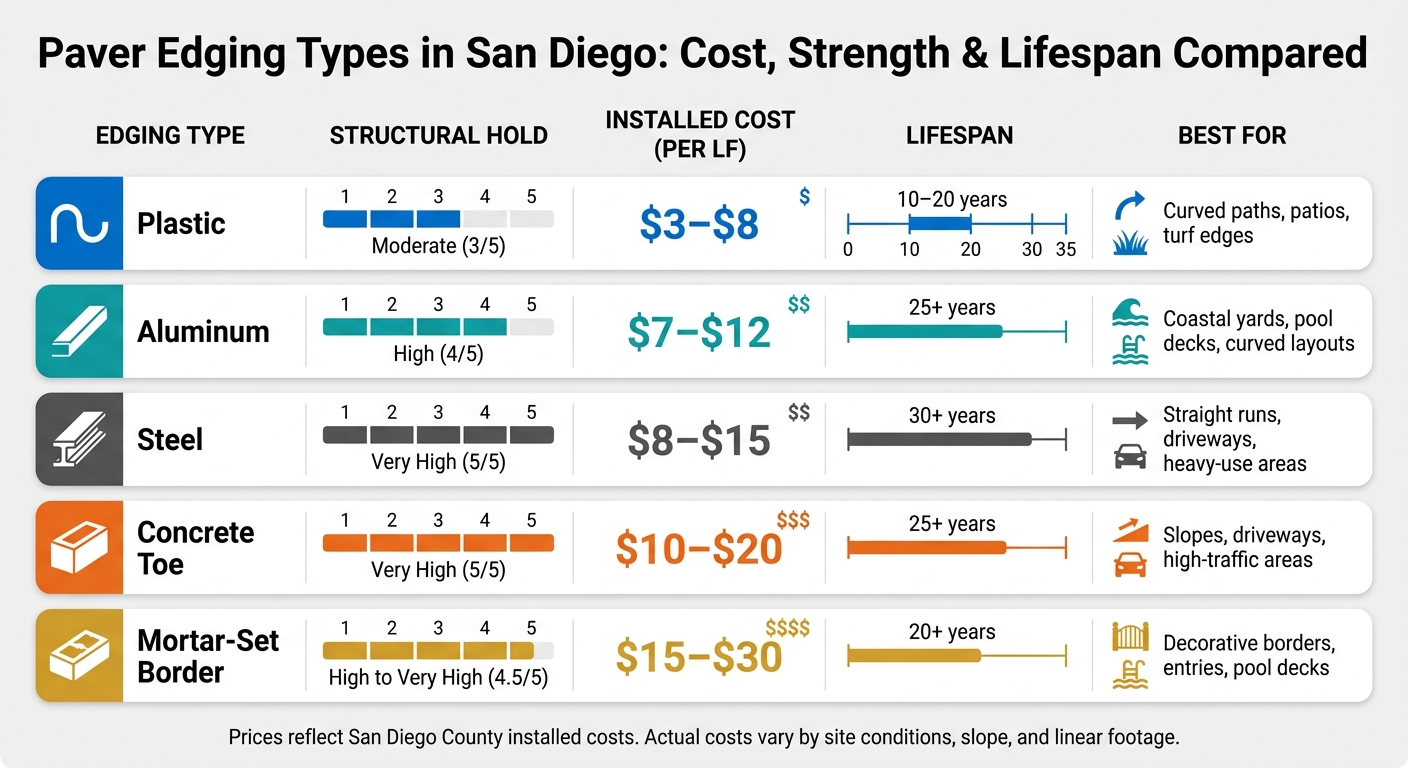
Paver Edging Types in San Diego: Cost, Strength & Lifespan Compared
The Real Cost of Landscape Curbing
sbb-itb-2b3b7d5
1. Concrete Toe / Concrete Edge Beam
A concrete toe, sometimes called a haunch, is a poured concrete border that locks the outer edge of pavers in place. That helps stop edge creep from foot traffic and vehicle loads. In San Diego, it's the go-to pick when strength matters most, especially on slopes or in areas with runoff and vehicle traffic pressing against the edge.
Structural Hold
The toe is poured as a wedge on top of the compacted base. It's usually about 4 inches wide and 6 inches deep, with the top tucked just below the paver surface so it stays out of sight.
"Concrete haunching remains the benchmark for structural reliability, particularly under vehicular or commercial loads." - Eric R. McQuiston, Landscape Architect
Installed Cost
In San Diego County, concrete toe edging usually costs $10–$20 per linear foot installed. For paver edges, that range often covers both materials and labor, though curves and slopes can push the price up. It takes more labor than the other three edging types, but it also gives you the strongest hold for driveways and sloped yards.
Climate Durability
San Diego's mild weather works well for concrete edging. Even so, base prep still matters, especially in inland areas where daily temperature swings are larger. One detail can make or break the result: don't add too much water to the mix during installation, because that weakens the finished restraint.
Best Project Fit
Concrete toe edging makes the most sense for:
- Driveways
- Heavy-traffic walkways
- Sloped yards where gravity and runoff add side pressure
It can also work as a flush mow strip next to turf. On the flip side, it's not a great match for tight decorative curves. After installation, allow 3 to 5 days before light landscaping and 7 days before heavy equipment goes over the area.
If your project is lighter-duty or you're watching costs, the next options cut price and install time, though they give up some holding power.
2. Plastic Paver Edge Restraint
Plastic edge restraint is the lowest-cost edging choice for most residential paver jobs in San Diego. It’s made from flexible polypropylene strips in an L-shaped profile and fastened into the compacted gravel base with 10-inch non-galvanized steel spikes driven through pre-drilled holes. The tradeoff is simple: lower price, less holding strength.
Structural Hold
Plastic edge restraint supports the outer course and helps limit edge creep. Non-galvanized steel spikes are the standard pick because surface rust helps the restraint grip the base over time. On a typical residential install, spikes are usually placed every 8 to 12 inches. In higher-load areas, installers should tighten that spacing.
One rule matters more than anything else here: the restraint has to sit directly on the compacted gravel base, never on the bedding sand. If it sits on sand, the restraint can move as the sand settles below it.
Installed Cost
Plastic is the least expensive edging material, at about $1–$3 per linear foot for materials alone. In San Diego, installed cost for a standard patio border usually lands between $600 and $1,500, based on total footage and site conditions.
Climate Durability
Inland San Diego has expansive clay soils that swell in wet periods and shrink in dry ones. Plastic can handle small soil shifts better than rigid edging, which is one reason contractors still use it on many home projects. But there’s a catch: it can creep over time. That’s why annual checks matter, especially in yards with full sun. UV-protected strips are the better pick in those spots.
Best Project Fit
Plastic edging makes the most sense for curved residential walkways, patio borders, and low-traffic turf edges. Installers can cut the connector ties between the triangular sections to bend the strip to almost any radius. As Polycor Inc. puts it:
"The flexible nature of plastic edge restraints makes it perfect for curved or flowing pathways where rigid materials would require complex fabrication."
- Polycor Inc.
That flexibility is the big selling point. If a path snakes through a yard, plastic is much easier to shape than a stiff edge system.
Still, it’s not the right pick for every job. Don’t use plastic edge restraint on driveways or permeable paver systems. Vehicle tire pressure can overpower the spikes, and open-graded stone bases don’t have enough fine material to hold those spikes well. For driveways and other high-load edges, step up to a stiffer option like metal edging. The next option gives you more rigidity without paying for a concrete pour.
3. Aluminum or Steel Paver Edging
Metal edging gives paver projects the stiffness that patios, walkways, driveways, pool decks, and other high-load edges need. That matters in coastal air, inland heat, and sloped yards, where paver edges deal with steady side pressure. It also sits in the middle ground between cheap plastic edging and heavy concrete restraint. So the big things to watch are material choice and anchor spacing.
Structural Hold
As one landscape specialist notes:
"Powder-coated steel edging, typically 1/8-inch thick and 4 to 6 inches deep, provides the strongest edge support for paver patios."
Steel is the stiffest option here. Aluminum gives up a bit of stiffness, but it's much easier to shape. It can bend into curves as tight as 2 to 3 feet without special tools, which makes it a good fit for curved paths and pool surrounds.
For both materials, use 10-inch spikes spaced 8 to 12 inches apart. For driveways, tighten that spacing to improve hold.
Installed Cost
Aluminum usually costs $7–$12 per linear foot for materials, while steel comes in at $8–$15 per linear foot. Installed pricing usually falls between $600 and $1,500 for smaller runs and $1,500 to $3,500+ for bigger or more complex layouts.
Soil type can change the math fast. Rocky or clay-heavy soil can push labor costs up by 30% to 50% because trenching takes more time. In San Diego, the bigger cost issue is often long-term performance - especially how each metal deals with coastal exposure and shifting soil.
Climate Durability
Aluminum doesn't rust, rot, or turn brittle, and it can last 25+ years with very little upkeep. Steel is the better pick when rigidity matters most, but near the ocean it should be powder-coated or galvanized to cut down on corrosion.
In inland yards, where heat swings and soil movement can be rough on edging, both metals hold up better than plastic because they resist warping and keep their shape. One thing to watch: Corten steel can stain light pavers or nearby concrete during the first few seasons.
Best Project Fit
Aluminum works well for curved walkways, pool decks, and coastal yards. Steel makes more sense for driveways and long, straight runs. On slopes, use galvanized spikes driven at a 45-degree angle to help resist upward and outward soil pressure.
Both materials should sit about 1/8" to 1/4" below the paver surface, which keeps the edge low-profile and out of sight. If you want a bonded border that trades bendability for the strongest lock-in, the next option moves in that direction.
4. Mortar-Set Border
A mortar-set border, also called a bond beam, is the rigid option: a concrete curb with border stones set in mortar. It creates a permanent frame around the perimeter and gives the paving field a finished border - like a soldier or sailor course along the edge. It costs more to build, but it delivers the cleanest look and the strongest edge hold.
Structural Hold
This method gives you the strongest perimeter lock. That makes it the right choice for driveways and other high-load edges where lateral pressure is constant.
Installed Cost
Decorative brick borders set in mortar usually cost $6–$15 per linear foot, based on the block and pattern. For poured or precast concrete edging, expect $8–$20 per linear foot installed. Bigger or more complex jobs - custom angles, curved borders, or reinforced sub-slabs - can land in the $1,500 to $3,500+ range.
Climate Durability
The main local issue is expansive clay soil, which is common in inland areas like Lakeside and Alpine. That soil swells and shrinks with the seasons. Using fiber-modified concrete in the border mix helps cut the risk of cracking from that kind of soil movement.
Best Project Fit
Use this when San Diego site conditions call for both a polished look and maximum edge stability. Mortar-set borders make the most sense for driveways, porcelain patio installations, pool decks, and front entry walkways where looks and structural performance both matter.
They also work well for projects with complex corners or curves, since bonded border stones hold those shapes much better than flexible restraints. For clean, hidden containment, keep the haunch at least 1 inch below the finished surface and about halfway up the paver side.
Next, compare all four edging types by strength, cost, and maintenance.
How the Four Edging Types Compare on Performance and Cost
After looking at each edging type on its own, it helps to see them side by side.
Here’s the short answer: pick edging based on load, budget, and expected lifespan. That matters even more in San Diego, where coastal moisture, inland heat, and sloped yards can each put different pressure on the perimeter.
The main tradeoff is simple: as strength goes up, cost usually goes up too.
| Edging Type | Structural Hold | Installed Cost (per LF) | Lifespan | Best Project Fit |
|---|---|---|---|---|
| Plastic | Moderate | $3 – $8 (installed) | 10–20 years | Patios, curved walkways |
| Aluminum | High | $7 – $12 | 25+ years | Coastal sites, pool decks, modern designs |
| Steel | Very High | $8 – $15 | 30+ years | Straight-run formal designs |
| Concrete Toe | Very High | $10 – $20 | 25+ years | Driveways, heavy-traffic areas |
| Mortar-Set Border | High | $15 – $30 | 20+ years | Decorative borders, luxury estates |
Upfront cost matters. But in many cases, lifespan is what ends up deciding value. A lower-cost edge can look good on day one, then need repairs much sooner. A higher-cost option often asks for more money at the start, but it may hold up far longer with less trouble.
In San Diego, total project costs usually run from a few hundred dollars for short paths to several thousand dollars for driveways and pool decks. The final number depends on total linear footage and how tricky the site is.
One point is easy to miss, but it makes a big difference: the material alone won’t save a bad install. Every edging type needs the compacted aggregate base to extend 6–8 inches beyond the paver edge so the anchors can grip the way they should. On slopes, that extra base width is often the thing that keeps the whole edge from giving way.
Edging costs stay modest on their own, but they add up fast once folded into a full paver project. Financing through GreenSky or Lyon Financial covers the combined total instead of a separate edging line item. Review current payment plans before picking an edging type.
Pros and Cons of Each Paver Edging Type
Each edging type has a best use case, and each one comes with a downside. The tradeoff is pretty simple: every option fixes a different problem.
Concrete toe is rigid and does a good job resisting movement under heavy loads. The downside is the work involved. It takes more labor, needs time to cure, and can crack when the ground shifts from runoff or seasonal soil movement. It can also leave grass thin or dead right along the edge, so it makes more sense where turf doesn't meet the border.
Plastic edge restraint is the lowest-cost option and the easiest to bend around curves. Its weak spot is long-term movement and UV wear, especially in full sun. Heat and soil movement over compacted bases can cause the spikes to creep over time.
Aluminum edging gives you a clean, low-profile edge and does not rust. In coastal San Diego, that matters. Salt air can eat away at other metals, so aluminum has a clear edge there. The catch is the higher upfront cost, though it needs very little upkeep.
Steel edging brings a lot of strength, especially for straight runs and heavy-load areas. Near the coast, it should have a galvanized or powder-coated finish to help stop rust. If it doesn't, corrosion can stain nearby pavers.
Mortar-set borders give the most polished, high-end look. Brick or stone soldier courses add weight and rigidity, which helps hold pavers in place under traffic. The tradeoff is cost and permanence. In inland areas with expansive clay soil, that permanence can become a headache because cracks from ground movement are harder to fix later.
Here is the shortest way to compare them side by side.
| Edging Type | Major Advantages | Major Limitations | Maintenance Expectations | Ideal Use Cases |
|---|---|---|---|---|
| Concrete Toe | Rigid; high load resistance; very durable | Labor-intensive; curing time; can crack; can create thin or dead grass at the edge | Biannual inspection for hairline cracks; seal as needed | Driveways; sloped areas; large patios |
| Plastic | Lowest cost; flexible for curves | Not for heavy loads or permeable/open-graded bases; spikes can creep; UV wear in full sun | Seasonal check for spike movement or brittleness | Curved walkways; garden beds; budget projects |
| Aluminum | Rust-resistant; low-profile edge; precise lines | Higher upfront cost; not for heavy vehicular use | Minimal; occasional cleaning; check stakes after storms | Coastal yards; modern/minimalist designs |
| Steel | Maximum strength; good for heavy vehicles | Can rust if untreated near coastal air; harder to install | Monitor for rust or corrosion annually | Driveways; heavy-load areas |
| Mortar-Set Border | Premium finish; added weight and rigidity; very stable | Most expensive; requires skilled labor; once installed, changes are difficult | Seasonal check for shifting or mortar cracks | Luxury patios; traditional brick patios; formal gardens |
Conclusion
After comparing the options, the best edging choice comes down to yard slope, moisture exposure, traffic load, and how much upkeep you're willing to do.
For coastal projects, aluminum is the best low-maintenance pick because it resists coastal corrosion.
For driveways and other high-load areas, you'll want concrete haunching or steel edging.
Sloped yards need firmer containment. That makes concrete haunching or mortar-set borders the safer long-term choice for keeping pavers in place and cutting erosion.
Plastic can work in light-duty areas, but sun exposure and soil movement can shorten its lifespan.
If low maintenance is your top concern, aluminum is the best fit. Plastic costs less upfront, but it usually needs more attention over time.
Coastal exposure, inland heat, slope, and traffic should guide the final call. It's a detail that gets overlooked in a lot of backyard remodeling plans — edging feels minor next to the pavers themselves, but the crew at United Turf & Pavers has seen plenty of jobs where the wrong edging undid an otherwise solid installation within a couple of seasons. A site assessment should match the edging to slope, moisture, sun exposure, and traffic.
FAQs
Do I need paver edging for every project?
Yes - paver edging is needed for almost every paver project if you want the surface to hold its shape over time. It helps keep pavers from shifting, sinking, or spreading when they’re under pressure.
The main exception is when the edge runs into a permanent, solid structure, such as a home foundation, steps, a retaining wall, or a concrete curb. In those cases, that structure can act as the restraint. Otherwise, you need edge restraint around the full perimeter to help limit erosion, weed intrusion, and instability.
Which edging is best for a sloped yard?
For a sloped yard, the best edging is one that can take a beating and deal with soil or grade movement. Engineered, flexible concrete-based edge restraints are a strong pick because they can float and flex with sub-base movement while still giving the edge solid support.
If you want more long-term stability, a poured concrete haunch or a mortar-set stone border can help stop erosion and keep the edge from spreading. One detail matters a lot here: install the restraint on the compacted base, not the bedding layer, so it’s less likely to shift.
How do I know if plastic edging is enough?
Plastic edging is usually enough for pedestrian-only patios and walkways built with a dense-graded base. It also works well for curved layouts because it bends more easily and costs less than other edge restraints.
That said, it’s not a good pick for driveways, high-traffic areas, or open-graded permeable base systems. For the best results, install it on a compacted aggregate base and place the spikes about 8 to 10 inches apart.