.webp)
.webp)

HOA-Friendly Artificial Turf Options
July 8, 2026
The short answer: your best shot at HOA approval is usually landscape turf, while pet turf, play area turf, and putting green turf can work when the product, placement, and install match the yard’s use.
If you want turf that clears HOA review, focus on four things right away: looks, drainage, heat, and paperwork. In this article, you’ll see how the four main turf types compare, where each one fits best, and which details often matter most in a California HOA application under Civil Code §4735.
Here’s the simple breakdown:
- Landscape turf: best for curb appeal and front-facing lawn areas
- Pet turf: best for dog runs and odor control
- Play area turf: best for kids, heavy foot traffic, and padded use zones
- Putting green turf: best for golf use, but often gets more HOA review
You’ll also find key numbers that shape the decision:
- Drainage: about 30+ inches per hour for landscape turf and 30–100+ inches per hour for pet and play turf
- Lifespan: about 15–20 years for many landscape systems with proper install
- Heat: turf can exceed 160°F in direct sun
- Installed cost: often runs from about $11 to $35 per sq. ft., based on turf type and base work
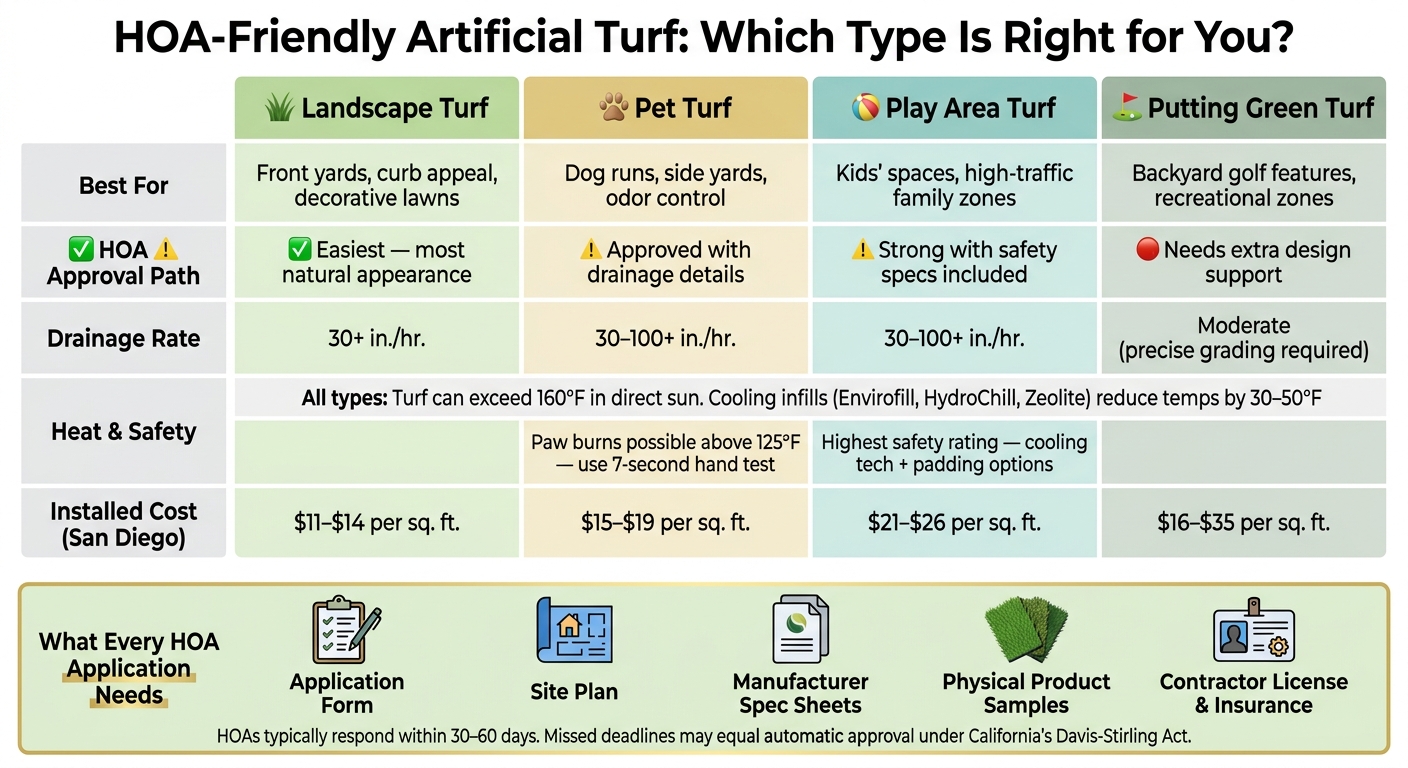
HOA-Friendly Artificial Turf Types: Side-by-Side Comparison
Quick Comparison
| Turf Type | Best For | HOA Approval Path | Main Watch-Out | Typical Installed Cost |
|---|---|---|---|---|
| Landscape turf | Front yards, main lawns, visible areas | Usually the easiest | Heat in full sun | $11–$14/sq. ft. |
| Pet turf | Dog runs, side yards, pet zones | Often approved with drainage details | Higher cost and odor-control setup | $15–$19/sq. ft. |
| Play area turf | Kids’ spaces, active backyards | Strong when safety specs are clear | Heat and price | $21–$26/sq. ft. |
| Putting green turf | Backyard golf feature | Often needs more design support | Looks less like a normal lawn | $16–$35/sq. ft. |
The main point is simple: the turf type matters, but the way you present it matters just as much. A clean application with samples, spec sheets, drainage info, and a site plan often makes the difference.
sbb-itb-2b3b7d5
1. Landscape Turf
Landscape turf is the go-to HOA option for front yards, backyards, side yards, and planting strips because it looks the most like a well-kept natural lawn without the constant upkeep. In most cases, HOAs look at this turf in a pretty simple order: first, does it look natural? Then they look at how well it drains and how it holds up over time.
Visual Realism
For HOA approval, appearance usually comes first. That means turf with multi-tone blades, brown thatch, a 1.5–2.0-inch pile height, and 50–65 oz per sq yd face weight tends to fit the mark. Those mixed blade colors and the brown thatch matter more than many homeowners expect. They help the turf blend better in both sunny and shaded spots, so it doesn’t stand out in a bad way.
"Quality artificial turf with natural color variations and proper installation typically maintains curb appeal, especially when compared to drought-stressed natural lawns." - United Turf & Pavers
Looks may get the first nod, but drainage and wear often decide whether the installation keeps performing well year after year.
Drainage and Durability
Modern landscape turf usually uses perforated backing with a compacted aggregate base. That base is often 2–3 inches of Class II road base, graded at a 1.5–2.0% slope, so water can move through the turf and away from the yard. In good installations, drainage rates of 30+ inches per hour are common.
On top of that, UV-stabilized fibers help limit fading in the Southern California sun. With proper installation and basic upkeep, landscape turf often lasts 15–20 years.
Safety and Compliance
For HOA review, it helps to submit turf that is lead-free and non-toxic, with edges secured in place, smooth transitions to sidewalks and pavers to cut down trip hazards, and drainage that stays clear and unobstructed.
Best Backyard Use
Landscape turf works best in main lawn areas that are visible from the street, side yards that are hard to irrigate, and casual outdoor hangout spaces. A simple approach usually works best: use landscape turf for the main lawn, then use specialty turf only where the yard has a job to do.
That could include:
- pet areas
- play zones
- putting spaces
This keeps the yard looking consistent and HOA-ready, while giving higher-use spots a surface built for that purpose.
2. Pet Turf
Pet turf does a different job than landscape turf. Landscape turf is mostly about curb appeal. Pet turf is built to handle daily dog use, with a bigger focus on drainage and odor control so smells don’t get trapped in the surface.
Visual Realism
Even with that extra performance focus, pet turf still has to look natural enough to meet HOA standards. Most HOAs will still look at color, texture, and how close it looks to real grass.
The main difference is in how the fibers are made. Pet turf usually uses shorter, denser blades that stand up better to matting and digging. Multi-tone fibers also help the surface keep a more natural grass look instead of looking flat or fake.
Drainage and Durability
Pet turf systems are made to drain 30–100+ inches per hour with permeable backing and a 3–4 inch layered base of crushed drain rock. That drainage setup matters a lot. In pet areas, weed barrier fabric should be skipped because it can trap moisture and bacteria.
For odor control, use an infill like Zeolite or Envirofill. If the yard gets heavy use, Envirofill is usually the better fit. In homes with more than one dog, it also tends to last better over time.
"Real odor control comes down to proper infill selection and drainage - not the turf fibers themselves." - United Turf & Pavers
These upgrades matter even more in full-sun yards, where heat turns into the next HOA issue and a pet safety problem.
Safety and Compliance
Heat is a serious concern in inland San Diego yards. Turf surfaces can go past 160°F in direct afternoon sun, and paw pads can burn in under 60 seconds on surfaces above 125°F. Cooling infills or heat-reflective fibers can lower surface temperatures by 30–50 degrees, which can make a big difference on summer afternoons.
A simple test helps here: press the back of your hand on the turf between 10 a.m. and 4 p.m. If you can’t keep it there for 7 seconds, it’s too hot for your dog.
For HOA approval, submit:
- Samples
- Product specs
- Drainage data
- Infill details
Best Backyard Use
For many families, pet turf shares space with a play area or lounge zone. It tends to work best in dedicated dog runs, side yards, and high-traffic backyard areas where natural grass would wear out fast.
Pet-ready systems also cost more because of the extra drainage layers and antimicrobial infill.
3. Play Area Turf
When a backyard needs a surface for kids, HOA review goes beyond curb appeal. Now the focus is on durability, safety, and heat control. Play area turf is made for that kind of space. It keeps a natural look, stands up to heavy foot traffic, and gives kids a safer place to play. In most cases, HOAs look at three things: how natural it looks, how flat it stays over time, and how it deals with heat.
Visual Realism
Play area turf is designed to look more like natural grass than the stiff, plastic-looking products people worry about. It uses multi-tone, longer blades for a more natural appearance, along with higher-density fibers that help resist matting under heavy foot traffic.
Drainage and Durability
This type of turf is also built to handle daily use. It uses a permeable backing and a 3–4 inch compacted base, which supports drainage rates of 30–100+ inches per hour and helps the surface stay more stable over the long term.
Safety and Compliance
Heat is a big deal here, especially in inland San Diego. In direct sun, uncooled turf can hit 160°F or more. That’s hot enough to turn a play area into a no-go zone. Cooling infills like Envirofill or HydroChill can drop surface temperatures by 30–50°F.
For HOA approval, it helps to come prepared. A strong submission usually includes:
- Manufacturer specs
- Drainage data
- Product samples
- Warranty details
- Contractor credentials showing the turf is lead-free and non-toxic
Best Backyard Use
Placement matters just as much as the turf itself. Open, sunny areas heat up the fastest, so play area turf tends to work best in shaded play zones. That includes north-facing yards, spaces under pergolas or shade sails, and areas beneath mature trees. Installed costs usually fall between $21 and $26 per sq. ft.
4. Putting Green Turf
Putting green turf is a specialty surface built for ball roll, not for looking like a standard lawn. For HOA review, that point matters a lot. The surface needs to look planned and purposeful, not like someone swapped out grass for a low-cut fake lawn. It delivers the strongest specialty play, but it also looks the least like a normal lawn.
Visual Realism
This is usually where HOA approval gets a bit more design-focused. A short, dense pile reads like a golf green, not a yard. That’s the trade-off.
Higher-end products can soften that look with multi-tonal blade colors and mixed blade heights. Even so, HOAs that want a more natural appearance may still push back. A steady grain direction helps the surface look even from edge to edge. When you submit for approval, it helps to bring physical samples and manufacturer spec sheets so the review committee can judge the color and product quality in person. Because the pile is so short, it often reads as a feature rather than a lawn, which makes placement a big part of the decision.
Drainage and Durability
Performance is the main draw here. A proper install uses a stable, well-graded compacted aggregate base. That base helps support even ball roll and solid drainage over time.
Safety and Compliance
Cooling infills like zeolite or silica sand can lower surface temperatures by 30–50°F, which can make the area safer for barefoot use during the middle of the day.
Best Backyard Use
Putting greens tend to work best as dedicated backyard features, not as full-yard coverage. Installed costs usually fall between $16 and $35 per sq. ft., depending on the size and any custom features.
They’re often a good fit for sloped parts of a yard that don’t do much else. HOAs are often more at ease with these setups when the design includes natural borders or setbacks along property lines. Local site conditions matter too. In East County, adding a gopher wire layer can help protect the base from rodent damage. For HOA approval, placement and visibility matter just as much as product quality.
How Each Turf Type Holds Up for HOA Approval, Performance, and Design
After looking at each turf type on its own, the next move is to see how they compare under HOA review. This is where things get practical. Every option brings a different mix of approval odds, day-to-day performance, and visual fit.
Landscape turf has the easiest path to approval because its multi-tone natural shades and mid-density face weights tend to line up best with common HOA standards. The other turf types can still pass review, but they usually need more backup in the application.
Performance changes by use case. Pet turf drains the fastest. Play area turf does the best job resisting matting. Putting greens are more specialized and need exact grading to keep ball roll even and smooth.
Play area turf stands out most on safety. In inland San Diego, turf can top 160°F in peak sun, so cooling features matter a lot in spaces used by kids and pets. Landscape turf and pet turf can also use cooling infills like Envirofill or zeolite, but those details should be spelled out clearly in the ARC submission.
The table below gives a side-by-side view of how each option compares. Installed cost ranges reflect common San Diego pricing:
| Turf Type | Curb Appeal | Drainage & Durability | Safety & Compliance | Best Backyard Use | Installed Cost |
|---|---|---|---|---|---|
| Landscape | Highest; multi-tone natural shades | Standard; 30+ in./hr. | High; non-toxic, lead-free | Front yards, decorative curb appeal | $11–$14/sq. ft. |
| Pet Turf | Moderate to High | Superior; 30–100+ in./hr. | High; antimicrobial, non-toxic | Dog runs, side yards, active pet zones | $15–$19/sq. ft. |
| Play Area | Moderate to High | High; resists matting | Highest; cooling tech and padding options | Under play structures, high-traffic family zones | $21–$26+/sq. ft. |
| Putting Green | Specialized; golf-grade | Moderate; precise grading | Standard; non-slip, low-pile | Recreational zones, custom backyard features | $16–$35/sq. ft. |
The turf itself matters, sure. But in many cases, the application package is what swings the decision. Most San Diego HOAs want a full submission that includes:
- The application form
- A site plan
- Manufacturer spec sheets
- Physical product samples
- Your contractor's California license number and insurance certificates
Many HOAs reply within 30 to 60 days. If they miss that deadline, the request may be treated as automatically approved under the Davis-Stirling Act. That timing can matter a lot when a project is on a tight schedule.
A physical sample also helps more than people think. Committees can judge the color and texture in person instead of guessing from a brochure or photo. And if drainage might come up as an issue, it helps to include base prep details such as 4 to 6 inches of compacted aggregate.
Pros and Cons of Each Turf Type for HOA Approval
Each turf type tends to move through HOA review in a different way. Some look more like natural grass. Others stand out for performance. And some need more paperwork to get across the finish line.
The simplest way to choose is to line up the turf with the HOA’s two main concerns: how it looks and how the space will be used.
Landscape turf is usually the easiest to get approved because it looks the most like a standard lawn. The trade-off is heat, especially in full sun.
Pet turf can be a strong option when hygiene and drainage are top concerns. That said, it usually costs more and needs more involved base prep.
Play area turf tends to appeal to HOAs that care about safety. But its dense, even look can seem less natural than landscape turf. In the application, it helps to lead with cooling and safety specs.
Putting green turf usually gets the most scrutiny because it looks like a specialty feature, not a lawn. It tends to work best when it’s presented as a separate backyard feature and backed up with physical samples, site plans, and product specifications.
The matrix below sums up the four options and where each one tends to help - or hurt - during approval.
| Landscape | Pet Turf | Play Area | Putting Green | |
|---|---|---|---|---|
| Approval Strengths | Easiest approval path; most natural appearance; lowest cost | Superior drainage; antimicrobial features address hygiene concerns | Safety-focused; durable under heavy use | Creates a dedicated recreation feature; stays functional year-round |
| Approval Risks | Can overheat in direct sun without cooling infill | Higher cost; requires more involved base prep | Premium price point; may need extra safety documentation | Short pile looks unlike standard grass; works best as a backyard feature |
Final approval still comes down to one thing: how clearly the application ties the turf type to the way the yard will be used.
Conclusion
The right turf type comes down to how you plan to use the yard. Landscape turf makes the most sense for front yards and decorative areas where curb appeal leads the way. Pet turf is the better pick when drainage and odor control matter most. Play area turf works well in busy family spaces, especially in sunny inland neighborhoods where cooling tech can make a big difference. Putting green turf fits best as a dedicated backyard feature, with short, dense fibers and precise grading for a natural ball roll.
For HOA approval, the design matters just as much as the turf itself. It helps to present the project as a full landscape plan, not just a turf install. Pairing turf with pavers and planting beds can ease common concerns about appearance. For drainage and stability, use a 3–4 inch compacted crushed-rock base. California law protects artificial turf, but the HOA still controls installation approval.
If one yard needs to do several jobs, zoning is usually the cleanest path. Split the space by use, like a pet run, a play area, and a decorative lawn. That approach is often easier to understand and easier to approve. United Turf & Pavers offers free design consultations for multi-zone layouts that meet HOA standards.
FAQs
What should I include in my HOA turf application?
Include a complete, well-organized package with:
- the application form and project description
- current yard photos and a site plan
- manufacturer specs, warranty details, and turf samples
- proof that your contractor is licensed and insured
Submitting everything before the committee deadline can help you avoid delays and extra information requests.
Which turf type is best for a front yard?
A mid-density artificial turf product is usually the best fit for a front yard. With face weights between 50 and 65 ounces per square yard, it gives you a more natural look while still holding up well in decorative, low-traffic spaces.
For hot, sunny areas, go with lighter, natural-toned blade colors. They can help the surface stay a bit cooler in the sun.
How can I keep artificial turf cooler in full sun?
Choose premium turf with advanced cooling technology. It can lower surface temperatures by 30–50°F, which makes a big difference on hot days.
During installation, use coated cooling infill or silica sand. That detail matters more than many people think, because infill plays a major role in how much heat the surface holds.
Shade helps the most when you're trying to cut heat buildup. Pergolas, shade sails, and retractable awnings all work well, especially against harsh afternoon sun. It also helps to pick lighter, natural-colored turf blades, since darker shades tend to absorb more heat.